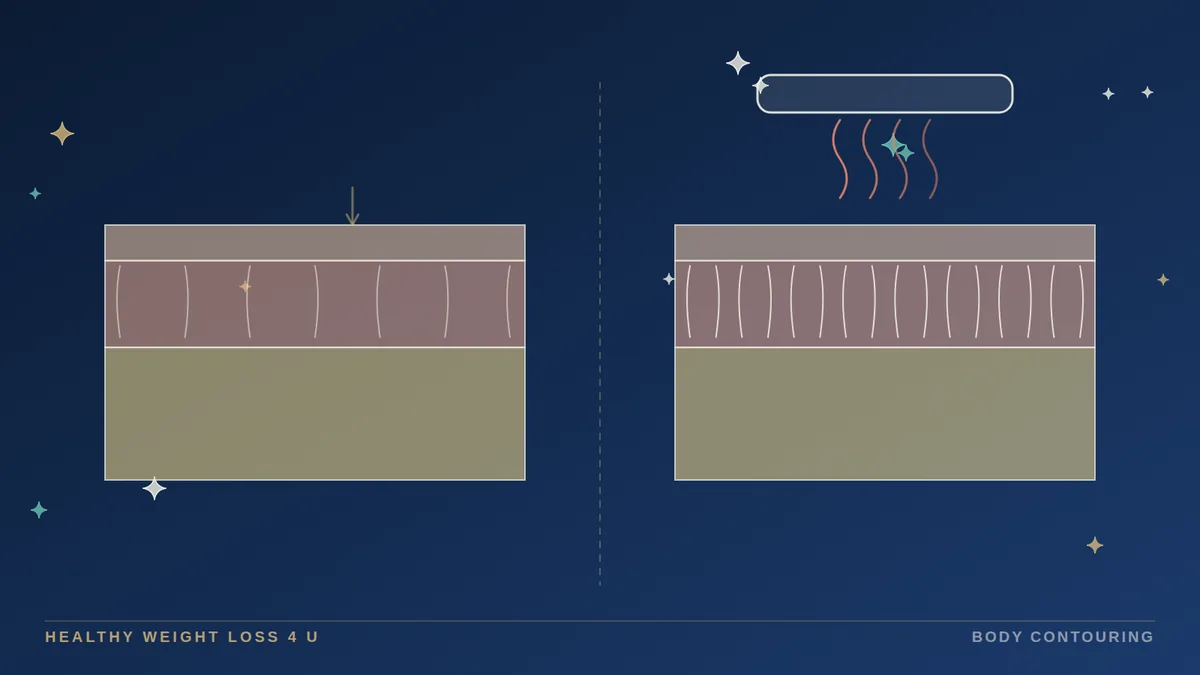
Skin that was stretched by excess weight may not fully retract after major weight loss, and surgery is the established treatment for large amounts of excess skin. Radiofrequency tightening is studied, but a systematic review found the evidence for skin laxity, especially on the body, to be low quality. FDA records for Venus Legacy list cellulite, minor muscle pain and circulation indications for body applicators, and facial wrinkles for separate applicators, not body skin tightening.
Key takeaways
- Carrying extra weight stretches skin and reduces its elasticity; after major weight loss it may not tighten to the new shape.
- A biopsy study found less elastic tissue in abdominal skin after surgical massive weight loss than after non-surgical massive weight loss (about 5% vs 6.8%), and both groups had lower collagen than normal skin reported in the literature.
- A 2015 review of 31 radiofrequency skin-laxity studies found low methodological quality: 96% had no control group, and only 11% targeted body laxity.
- FDA 510(k) records for Venus Legacy CX and Legacy Pro list cellulite, minor muscle aches and circulation for the body applicators; they do not list body skin tightening.
- Excess skin removal surgery is the established option for significant excess skin, with scars, recovery time and complication risks.
Why does skin loosen after weight loss?
Carrying extra weight stretches skin and underlying tissue, and after major weight loss the skin may not tighten to fit the new body shape. Cleveland Clinic describes it this way: stretched skin gradually loses elasticity and can hang loosely after major weight loss [2]. MedlinePlus notes that large losses, about 100 lb (45.4 kg) or more, can leave skin without enough elasticity to shrink back, with sagging most often on the face, arms, stomach, breasts and buttocks [1].
Extra skin is not only a cosmetic issue for some people. MedlinePlus notes that extra skin can cause rashes and infections [1]. Whether excess skin is causing symptoms is therefore a useful question to bring to a clinician.
Source: [3] Hany et al., Obes Surg 2024
What do biopsies show about skin after major weight loss?
Studies of skin tissue point to reduced elastic fibers and lower-than-normal collagen after massive weight loss. A 2024 study in Obesity Surgery compared skin biopsies from body-contouring operations in 38 patients with surgical massive weight loss after bariatric surgery and 39 with non-surgical massive weight loss. Abdominal skin had less elastic tissue in the surgical group (about 5% vs 6.8%, p = 0.029). Collagen content did not differ significantly between the groups, and both had lower collagen than normal skin reported in the literature [3].
Epidermal thickness did not differ significantly between the groups, and complications after abdominoplasty were not significantly different (p = 1.000) [3]. The authors listed a small sample and the lack of a normal-skin control group as limitations [3]. The study does not say how fast or how far each patient lost weight, and the sources reviewed for this article do not quantify how much age or speed of weight loss changes the outcome. Age-related skin changes also occur independently, and MedlinePlus is explicit that body contouring surgery will not stop age-related sagging [1].
Can non-surgical tightening treat loose skin?
Non-surgical devices may have a modest effect on mild laxity, but the evidence is weak, and none replaces surgery for large amounts of excess skin. The FDA lists the technology categories used for non-invasive body contouring, including radiofrequency (RF) that heats fat and skin tissue, light-based energy, therapeutic ultrasound and mechanical massage, and notes that not all RF devices are cosmetic-use devices [5].
The most useful systematic look at RF for skin laxity is a 2015 review in Anais Brasileiros de Dermatologia. It included 31 human studies, 61% on facial laxity and only 11% on body laxity (arms, abdomen, thighs, buttocks). Most studies reported positive results, but only 44% reported statistical significance. All scored 4 or lower on the PEDro scale, 96% had no control group, none used blinding, and few used an objective measure such as biopsy [4].
The review proposes that RF raises tissue temperature and stimulates new collagen formation, but states that the physiological mechanisms and required parameters are not clear, and calls the use of RF for skin laxity "still a myth to be clarified" [4]. This review is from 2015, and the sources reviewed here did not include a more recent systematic review of body skin tightening, so newer studies may exist that this article does not describe.
Safety also matters. The FDA lists RF risks as blisters, burns, skin color changes and scarring, and says RF is not for people with active implants, metal under the skin or certain tattoos. It states that all contouring devices can cause pain, redness, swelling, bruising and nodules, and that results may be temporary and may require repeat treatments [5].
What is the Venus Legacy FDA-cleared for?
FDA 510(k) records for the Venus Legacy platform list indications for cellulite appearance, minor muscle pain and circulation on the body applicators, and for facial wrinkles on separate applicators; they do not list body skin tightening or loose skin after weight loss. The FDA's GUDID device record for Venus Legacy lists the same cellulite, muscle pain and circulation uses and no skin-tightening use [8]; it does not list a 510(k) number, so the two 510(k) records below were read directly.
The Venus Legacy CX clearance (K143554) covers non-thermal RF combined with massage and magnetic field pulses for relief of minor muscle aches and pain, relief of muscle spasm, temporary improvement of local blood circulation and temporary reduction in the appearance of cellulite [6]. The Venus Legacy Pro clearance (K191528) carries those same indications for its 4D Body and 4D Face applicators, and adds an indication, with the OctiPolar or DiamondPolar applicators, for non-invasive treatment of moderate to severe facial wrinkles and rhytides in females with Fitzpatrick skin types I to IV [7].
The manufacturer's product page makes a separate distinction. It labels the wrinkle and cellulite indications as FDA-cleared, and it ties its skin tightening and circumferential reduction claims to CE Mark and Health Canada licensing, not to FDA clearance [9]. The Lighthouse Point clinic lists Venus Legacy among its devices; which configuration is in use should be confirmed with the clinic. A cleared indication for cellulite appearance is not an indication for skin laxity after weight loss, and this article does not claim one.
The Lighthouse Point clinic also lists Venus Bliss Max. Its FDA records list a diode laser for non-invasive lipolysis of the abdomen, flanks, back and thighs in people with a BMI of 30 or less, RF with massage and magnetic pulses for temporary reduction in the appearance of cellulite, and electrical stimulation for muscle conditioning [11][12]. Skin tightening is not among the listed indications.
| Record | Applicators | Cleared wording, in brief |
|---|---|---|
| Venus Legacy CX, K143554 [6] | LB2 and LF2 | Non-thermal RF with massage and magnetic field pulses: relief of minor muscle aches and pain, relief of muscle spasm, temporary improvement of local blood circulation, temporary reduction in the appearance of cellulite |
| Venus Legacy Pro, K191528 [7] | 4D Body (LB2), 4D Face (LF2) | Same four indications as above |
| Venus Legacy Pro, K191528 [7] | OctiPolar (LB1), DiamondPolar (LF1) | Non-invasive treatment of moderate to severe facial wrinkles and rhytides in females, Fitzpatrick skin types I to IV |
| Not found in these records | Body skin tightening or laxity, loose skin after weight loss, circumference reduction |
How does surgery compare with non-surgical options?
Surgery is the established treatment when excess skin is significant, and non-surgical options are better matched to mild laxity or to people who do not want or are not candidates for surgery. Body contouring after major weight loss mainly removes excess skin, and liposuction can be added for small areas of stubborn fat [10]. Cleveland Clinic lists arm lift, breast lift, lower body lift, panniculectomy (removal of the skin apron below the belly button), thigh lift, tummy tuck and facelift, often in staged operations [2].
Surgery is a larger commitment than any device treatment. Cleveland Clinic describes full recovery as taking several months, with final results taking up to two years. Pain typically lasts a few weeks, temporary drains may stay in for a week or two, heavy lifting and strenuous activity are avoided for at least six weeks, and return to work usually takes one to three weeks depending on the procedure [2]. Listed risks include bleeding, blood clots, bruising and swelling, numbness, infection and scarring from incisions, and results that fall short of expectations [2]. MedlinePlus adds poor wound healing, fluid collections that may need drainage, persistent loose skin and dissatisfaction with results [1]. Surgery also cannot be expected to produce weight loss beyond the weight of the removed skin [2], and it improves body shape without restoring a pre-weight-gain appearance [1].
| Non-surgical RF or similar devices | Excess skin removal surgery | |
|---|---|---|
| What it does | Heats tissue; proposed to stimulate collagen | Removes excess skin and tissue [2][10] |
| Best matched to | Mild laxity (based on the type of evidence available) | Significant excess skin |
| Evidence quality | Low for body laxity; 2015 review found 11% of studies on body [4] | Established procedures; complication risks documented [1][2] |
| Main downsides | Variable and often modest results; burns, blisters, scarring possible [4][5] | Scars, bleeding, infection, blood clots, fluid collections, persistent loose skin, months of recovery [1][2] |
Who is a candidate, and who is not?
For surgery, candidacy centers on stable weight, general health and realistic expectations. Cleveland Clinic lists maintaining your goal weight for at least six months, a commitment to healthy diet and exercise, not smoking, general good health and realistic expectations [2]. MedlinePlus says weight should usually be stable for about a year first and that smoking increases complications, so surgeons often require quitting first [1]. The two sources differ on the timeline, so the surgeon makes the call. ASPS adds that significant weight fluctuations may increase the risk of complications, that ideal candidates have reached or come as close as possible to their target weight, and that a board-certified plastic surgeon can help plan the timeline and choose procedures [10].
For non-surgical devices, no candidacy standard exists in the sources reviewed. The FDA contraindications for RF (active implants, metal under the skin, certain tattoos) apply [5], and the cleared indications above do not include skin laxity. Reasonable candidates are people with mild laxity who understand the limited evidence and accept modest and variable results. Those least likely to be well served are people expecting surgical-level tightening of large amounts of excess skin, people with implants or metal in the treatment area, and people who are still losing weight.
What this means in practice
Match the tool to the problem and ask for specifics. A small amount of laxity and a large apron of skin are different problems with different options, and an exam is the only way to tell which you have. Timing matters too: MedlinePlus notes that ongoing weight loss can cause more sagging and that regaining weight can strain a surgical site, which is why decisions about excess skin are generally made once weight has stabilized [1].
- Ask which cleared indication applies to your treatment area, and whether use for skin laxity would be outside the device's cleared wording.
- Ask what published evidence exists for the exact device and body area, and how long patients were followed.
- If significant excess skin causes rashes, sores or limits daily activity, ask a board-certified plastic surgeon about excess skin removal.
- Reach a stable weight before surgery, since weight fluctuation may raise complication risk [10].
- Treat weight management and skin treatment as separate decisions, each with a licensed clinician.
When to talk to a clinician
Talk to a licensed clinician if loose skin causes rashes, sores or trouble with daily activities, or before any energy-based treatment. Seek care promptly after a device treatment for blisters, burns, severe or lasting pain, or changes in skin color [5]. Healthy Weight Loss 4 U programs begin with a clinician evaluation, and a plastic surgeon is the right specialist to assess excess skin removal.
Frequently asked questions
Why do I have loose skin after losing weight?
Can radiofrequency tighten loose skin after weight loss?
Is Venus Legacy FDA-cleared for skin tightening?
How long should weight be stable before skin removal surgery?
What are the risks of excess skin removal surgery?
Do non-surgical tightening treatments have side effects?
Sources
- Considering plastic surgery after a large weight loss. MedlinePlus, U.S. National Library of Medicine, n.d.. medlineplus.gov/ency/patientinstructions/000958.htm
- Excess Skin Removal: What It Is, Surgery, Procedures & Recovery. Cleveland Clinic, n.d.. my.clevelandclinic.org/health/treatments/22017-excess-skin-removal
- Comparison of Histological Skin Changes After Massive Weight Loss in Post-bariatric and Non-bariatric Patients. Obesity Surgery (Hany et al.), 2024. link.springer.com/10.1007/s11695-024-07066-y
- Radiofrequency for the treatment of skin laxity: mith or truth. Anais Brasileiros de Dermatologia (Araujo et al.), 2015. scielo.br/j/abd/a/H44b5rY7LC4dPBNY9cjP3hd/?lang=en
- Non-Invasive Body Contouring Technologies. U.S. Food and Drug Administration, 2025. fda.gov/medical-devices/aesthetic-cosmetic-devices/non-invasive-body-c
- 510(k) K143554: Venus Legacy CX (summary and indications for use). U.S. FDA, Center for Devices and Radiological Health, 2015. accessdata.fda.gov/cdrh_docs/pdf14/K143554.pdf
- 510(k) K191528: Venus Legacy Pro (summary and indications for use). U.S. FDA, Center for Devices and Radiological Health, 2019. accessdata.fda.gov/cdrh_docs/pdf19/K191528.pdf
- Device record: Venus Legacy (Device Identifier 07290016540000). AccessGUDID, U.S. National Library of Medicine (FDA Global Unique Device Identification Database), n.d.. accessgudid.nlm.nih.gov/devices/07290016540000
- Venus Legacy product page. Venus Concept (manufacturer), n.d.. venus.ai/venus-legacy
- When is the time right for body contouring after major weight loss?. American Society of Plastic Surgeons, n.d.. plasticsurgery.org/news/blog/when-is-the-time-right-for-body-contourin
- 510(k) K213308: Venus BlissMAX (summary and indications for use). U.S. FDA, Center for Devices and Radiological Health, 2022. accessdata.fda.gov/cdrh_docs/pdf21/K213308.pdf
- 510(k) K220592: Venus BlissMAX (summary and indications for use). U.S. FDA, Center for Devices and Radiological Health, 2022. accessdata.fda.gov/cdrh_docs/pdf22/K220592.pdf
Keep reading
Body Contouring vs Weight Loss: Who Is a Candidate?
Read →Protect Muscle During Weight Loss: What the Evidence Shows
Read →Body Composition Analysis: Why the Scale Misleads You
Read →Health Benefits of 5 to 15 Percent Weight Loss
Read →Questions about your own situation? A clinician can review your history and goals. Related: Venus Legacy Skin Tightening.