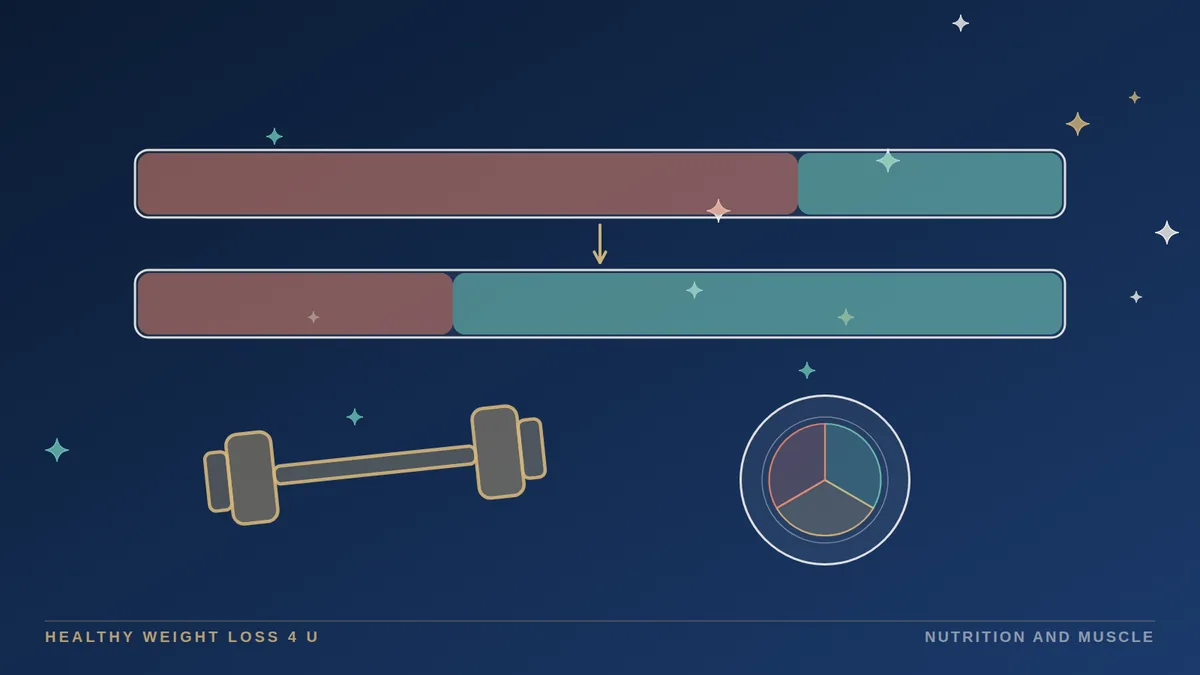
Weight loss by any method reduces some lean mass along with fat. In the DXA substudy of SURMOUNT-1, tirzepatide participants lost about 74% of their weight as fat and 26% as lean mass, similar to the placebo group's 75% and 25% [2]. Guidelines pair adequate protein with resistance training, but trials in people taking GLP-1 medicines have not shown whether specific protein targets or exercise programs change strength or function [2][3].
Key takeaways
- In the SURMOUNT-1 DXA substudy, lean mass fell 5.6 kg on tirzepatide versus 1.2 kg on placebo over 72 weeks, while fat mass fell 15.9 kg versus 3.6 kg [2].
- DXA lean mass is not the same as muscle; the 2025 joint advisory notes muscle is about half of lean mass [3].
- Published protein ranges of 1.0 to 1.2 g/kg/day (older adults) and 1.2 to 1.5 g/kg/day (illness) come from older-adult guidelines, not from GLP-1 trials [6][7].
- Resistance training in dieting older adults preserved more lean mass than diet plus aerobic exercise alone and raised strength by about 18% to 19% [9].
- Adding resistance training is supported by physical activity guidelines at 2 or more days a week [10][11].
- No GLP-1 trial reviewed here tested a protein target or training program against a control for muscle outcomes [2][3].
Do GLP-1 medicines cause muscle loss?
They reduce lean mass, as weight loss generally does, but most of the weight lost is fat. Lean mass includes muscle, water, organs and connective tissue, so a drop in lean mass is not a direct measure of lost muscle [3]. Two DXA (dual-energy X-ray absorptiometry) substudies of the large semaglutide and tirzepatide trials quantify the change.
The two substudies sit inside larger trials. STEP 1 enrolled 1,961 adults and found a mean weight change of -14.9% with semaglutide 2.4 mg versus -2.4% with placebo at 68 weeks [4]. SURMOUNT-1 enrolled 2,539 adults and found -15.0%, -19.5% and -20.9% with tirzepatide 5, 10 and 15 mg versus -3.1% with placebo at 72 weeks [5]. Individual results vary.
In the SURMOUNT-1 DXA substudy, 160 participants had baseline and week-72 scans (124 on pooled tirzepatide, 36 on placebo). Body weight fell 21.3% on tirzepatide versus 5.3% on placebo. Fat mass fell 15.9 kg (33.9%) versus 3.6 kg (8.2%), and lean mass fell 5.6 kg (10.9%) versus 1.2 kg (2.6%) [2]. About 74% of the weight lost was fat and 26% was lean mass with tirzepatide, compared with 75% and 25% with placebo [2].
In the STEP 1 DXA substudy of semaglutide 2.4 mg (140 participants, 68 weeks), body weight fell 15.0% versus 3.6% on placebo. Total fat mass fell 19.3% and visceral fat mass fell 27.4%, while total lean mass fell 9.7%; lean mass nonetheless rose by about 3 percentage points as a share of body mass because fat fell more [1]. The 2025 joint advisory, summarizing STEP 1, reports that of the weight lost 8.3 kg (62%) was fat mass and 5.3 kg (38%) was lean mass [3].
| Measure | SURMOUNT-1 DXA: tirzepatide (72 wk) | SURMOUNT-1 DXA: placebo | STEP 1 DXA: semaglutide 2.4 mg (68 wk) |
|---|---|---|---|
| Participants with DXA data | 124 | 36 | 95 (placebo 45) |
| Body weight change | -21.3% | -5.3% | -15.0% (placebo -3.6%) |
| Fat mass change | -15.9 kg (-33.9%) | -3.6 kg (-8.2%) | -19.3% |
| Lean mass change | -5.6 kg (-10.9%) | -1.2 kg (-2.6%) | -9.7% |
| Share of weight lost that was lean | about 26% | about 25% | 38% (reported in [3]) |
Source: [2] Look et al., Diabetes Obes Metab 2025
How much of lost weight is lean mass, and does it matter?
Published estimates of the lean share of weight lost range from about 26% in the SURMOUNT-1 DXA analysis to 38% in the STEP 1 figures cited by the joint advisory, so no single number applies to everyone [2][3]. The advisory also reports modeling data suggesting muscle loss represents 10% to 15% of total weight reduction in females and 20% to 25% in males, and notes that muscle is roughly half of lean mass [3]. The advisory adds that lean mass reduction is also affected by whether a person does strength training [3].
Whether this loss matters for strength and function is not settled by these studies. The SURMOUNT-1 DXA authors state that physical activity and nutrient intake were not evaluated and that no direct functional outcomes were measured [2]. A review of weight loss in general concluded that diet-induced weight loss reduces muscle mass without adversely affecting muscle strength, while high protein intake helps preserve lean mass without improving strength [8]. The joint advisory flags older adults and people who do not do resistance training as groups where low protein intake from reduced appetite may add to muscle loss and sarcopenia risk [3].
Diet-based weight loss also reduces lean mass, which is why the placebo arms matter. In the SURMOUNT-1 DXA analysis, placebo participants, who received lifestyle counseling and lost 5.3% of body weight, lost 1.2 kg of lean mass [2]. In the older-adult exercise trial, all three diet groups lost about 9% of body weight, and lean mass fell 5% with aerobic exercise, 2% with resistance training and 3% with combined training [9]. These are different populations and methods, so they illustrate the range rather than a benchmark.
How much protein do guidelines recommend during weight loss?
No guideline reviewed here gives a validated protein target for adults taking GLP-1 medicines. The 2025 joint advisory from the American College of Lifestyle Medicine, American Society for Nutrition, Obesity Medicine Association and The Obesity Society calls for adequate protein and strength training to preserve lean mass but specifies no gram amounts [3].
The numeric ranges that exist come from older-adult guidelines. The PROT-AGE Study Group recommends at least 1.0 to 1.2 g of protein per kg of body weight per day for people over 65, 1.2 g/kg/day or more for those who are also exercising, and 1.2 to 1.5 g/kg/day for those with acute or chronic disease [6]. The ESPEN Expert Group gives the same ranges: at least 1.0 to 1.2 g/kg/day for healthy older people and 1.2 to 1.5 g/kg/day with illness or malnutrition risk [7].
Two cautions apply. First, PROT-AGE notes that older adults with severe kidney disease (eGFR below 30 mL/min/1.73 m2) who are not on dialysis may need to limit protein [6]. Second, the review of weight-loss studies reported that high protein intake could have adverse effects on metabolic function, so more is not automatically better [8]. A clinician or dietitian should set a target based on age, kidney function and medications.
Does resistance training protect muscle during weight loss?
Resistance training is the best-supported strategy, though the strongest trial data come from older adults on diets, not from people on GLP-1 medicines. In a 6-month randomized trial of 160 older adults with obesity, all three exercise groups lost about 9% of body weight on a diet program. Lean mass fell 2.7 kg (5%) with aerobic exercise, 1.0 kg (2%) with resistance training and 1.7 kg (3%) with combined training [9].
Strength rose about 49 kg (19%) in the resistance group and 48 kg (18%) in the combined group, versus 5 kg (4%) with aerobic exercise. The combined group improved physical performance most, from 27.9 to 33.4 on a 36-point scale [9]. Exercise-related adverse events included musculoskeletal injuries [9]. A review of weight-loss studies likewise concluded that resistance-type exercise improves muscle strength [8].
For general guidance, the Physical Activity Guidelines for Americans advise adults to do muscle-strengthening activities of moderate or greater intensity involving all major muscle groups on 2 or more days a week, and CDC states the same [10][11]. The joint advisory recommends screening for resistance training and referral to an exercise physiologist or physical therapist where appropriate [3].
Strength work sits alongside, not instead of, aerobic activity. The same federal guidelines advise 150 to 300 minutes per week of moderate-intensity aerobic activity, or 75 to 150 minutes of vigorous activity, or an equivalent mix [10]. In the older-adult trial the combined program, which included both types, improved physical performance more than either alone, and hip bone mineral density still fell by about 0.5% to 3% across the exercise groups [9]. How these findings translate to younger adults or to people on GLP-1 medicines has not been tested in the trials reviewed here.
What is and is not proven?
The evidence supports a few statements and leaves several open. Use the lists below to separate the two.
Measurement is part of the uncertainty. The SURMOUNT-1 authors note that DXA was used instead of a four-compartment model, which may be more accurate, that visceral fat was estimated from the android region rather than measured directly, and that no multiplicity adjustment was applied [2]. The STEP 1 body-composition figures come from an exploratory analysis published as an abstract and report percentage changes, not kilograms [1].
- Supported: GLP-1 medicines in trials reduce fat mass more than lean mass, and lean mass is a minority of the weight lost [1][2].
- Supported: In older adults on a diet, resistance training preserved more lean mass and raised strength more than diet with aerobic exercise alone [9].
- Supported: Guidelines for older adults specify 1.0 to 1.5 g/kg/day of protein depending on health status [6][7].
- Not established: that any protein target changes strength, falls or fractures in people taking GLP-1 medicines; the SURMOUNT-1 DXA analysis measured no functional outcomes [2].
- Not established: the lean-mass share for any individual; DXA results came from small subgroups, with only 36 placebo participants in the SURMOUNT-1 analysis, and authors caution that subgroup findings were post hoc [2].
- Not established: whether the lean mass lost is clinically harmful; DXA lean mass includes more than muscle [3].
What this means in practice
If you are losing weight with or without medication, the evidence-based priorities are modest: eat adequate protein at a level your clinician or dietitian sets for you, do muscle-strengthening activity at least 2 days a week, and consider tracking body composition as well as scale weight [3][10]. Reduced appetite can lower protein intake, which the joint advisory identifies as a contributor to muscle loss and sarcopenia risk [3]. The realistic goal is to limit lean mass loss and keep strength and function, because none of the weight-loss groups in the trials reviewed here avoided lean mass loss entirely [2][9]. Meal replacements are among the services offered at both clinics; whether they suit you is a decision for your clinician or dietitian.
At Healthy Weight Loss 4 U, every program begins with a clinician evaluation, and body composition analysis, counseling and meal replacements are offered at both the Lighthouse Point, FL and Highlands Ranch, CO clinics. Body composition analysis estimates fat and lean mass and can show how they change over time, although accuracy depends on the method and device used.
When should you talk to a clinician?
Raise these points with a licensed clinician before changing protein intake or starting a new training program:
- You have kidney disease or reduced kidney function, because protein limits may apply [6].
- You are over 65, frail, or have fallen recently, because sarcopenia risk and exercise injury risk both rise; the older-adult exercise trial reported exercise-related musculoskeletal injuries [3][9].
- You notice new weakness, difficulty climbing stairs or rising from a chair, or unintended rapid loss of strength during weight loss.
- You eat very little because of nausea or low appetite and are unsure how to meet protein needs; see the companion article on managing GLP-1 side effects.
Frequently asked questions
How much muscle do you lose on a GLP-1 medicine?
Is muscle loss on GLP-1 medicines worse than with dieting?
How much protein should I eat while losing weight?
Does strength training help preserve muscle during weight loss?
Can body composition analysis detect muscle loss?
Do protein supplements prevent muscle loss on GLP-1 treatment?
Sources
- Impact of Semaglutide on Body Composition in Adults With Overweight or Obesity: Exploratory Analysis of the STEP 1 Study (conference abstract; no separate full publication found). Journal of the Endocrine Society 5(Suppl 1):A16-A17 (Wilding JPH et al.), 2021. doi.org/10.1210/jendso/bvab048.030
- Body composition changes during weight reduction with tirzepatide in the SURMOUNT-1 study of adults with obesity or overweight. Diabetes, Obesity and Metabolism 27(5):2720-2729 (Look et al.); a correction notice was published 20 August 2025 (DOI 10.1111/dom.70050), 2025. doi.org/10.1111/dom.16275
- Nutritional Priorities to Support GLP-1 Therapy for Obesity: A Joint Advisory From the ACLM, ASN, OMA and The Obesity Society. American Journal of Lifestyle Medicine (Mozaffarian et al.), 2025. pmc.ncbi.nlm.nih.gov/articles/PMC12125019/
- Once-Weekly Semaglutide in Adults with Overweight or Obesity (STEP 1). N Engl J Med 384:989-1002 (Wilding et al.), 2021. doi.org/10.1056/NEJMoa2032183
- Tirzepatide Once Weekly for the Treatment of Obesity (SURMOUNT-1). N Engl J Med 387:205-216 (Jastreboff et al.), 2022. doi.org/10.1056/NEJMoa2206038
- Evidence-based recommendations for optimal dietary protein intake in older people: a position paper from the PROT-AGE Study Group. J Am Med Dir Assoc 14(8):542-559 (Bauer et al.), 2013. doi.org/10.1016/j.jamda.2013.05.021
- Protein intake and exercise for optimal muscle function with aging: Recommendations from the ESPEN Expert Group. Clinical Nutrition 33(6):929-936 (Deutz NEP et al.), 2014. doi.org/10.1016/j.clnu.2014.04.007
- Preserving Healthy Muscle during Weight Loss. Advances in Nutrition 8(3):511-519 (Cava, Yeat, Mittendorfer), 2017. doi.org/10.3945/an.116.014506
- Aerobic or Resistance Exercise, or Both, in Dieting Obese Older Adults. N Engl J Med 376(20):1943-1955 (Villareal DT et al.), 2017. doi.org/10.1056/NEJMoa1616338
- Physical Activity Guidelines for Americans, 2nd edition. U.S. Department of Health and Human Services, 2018. odphp.health.gov/sites/default/files/2019-09/Physical_Activity_Guideli
- Physical Activity Recommendations for Adults. Centers for Disease Control and Prevention, accessed 2026. cdc.gov/physical-activity-basics/guidelines/adults.html
Keep reading
Body Composition Analysis: Why the Scale Misleads You
Read →Protein, Meal Planning and Meal Replacements for Weight Loss
Read →Metabolic Adaptation and Weight Loss Plateaus Explained
Read →How GLP-1 Medications Work for Weight Loss
Read →Questions about your own situation? A clinician can review your history and goals. Related: Personalized Weight Loss Counseling.