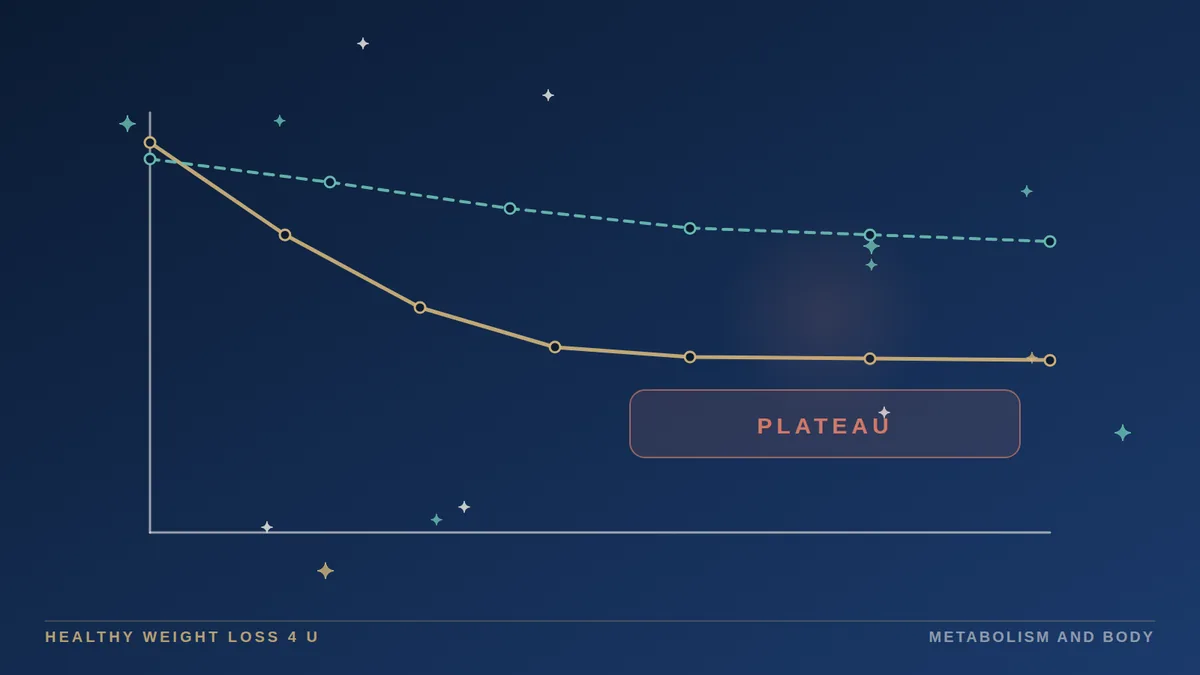
Metabolic adaptation is a drop in energy expenditure that exceeds what the smaller body predicts, and it comes with hormone changes that raise hunger, so weight loss slows and regain pressure rises. The Biggest Loser follow-up measured an adaptation of about 500 kcal per day six years later, but in only 14 people. Plateaus are expected, and clinical reviews favor reassessment, protein, resistance training and, where appropriate, medication over further restriction.
Key takeaways
- Adaptive thermogenesis is the part of the fall in energy expenditure that body size does not explain.
- The Biggest Loser follow-up (14 participants) found a metabolic adaptation of -499 kcal per day at six years, but the group is small and atypical.
- In a 50-person study, appetite hormone changes and increased hunger were still present 62 weeks after a very-low-energy diet.
- Plateaus typically appear weeks to months into a program, and restriction alone rarely reverses them.
- Reassessment of intake, activity, lean mass and medical options with a clinician is the evidence-supported response.
What is metabolic adaptation?
Metabolic adaptation, also called adaptive thermogenesis, is a fall in energy expenditure that exceeds what the loss of body mass alone would predict. It is one reason weight loss slows over time and why weight is hard to keep off [3][4].
A smaller body always burns fewer calories than a larger one. Adaptive thermogenesis is the extra reduction on top of that. Rosenbaum and Leibel describe it as a coordinated set of metabolic, behavioral, hormonal and autonomic responses that push body fat back toward a level the brain treats as usual, seen in both lean and obese people, with the hormone leptin playing a major role. They also note that most people who lose weight regain it, with over 80% returning to their prior body fatness [4].
The classic measurement came from Leibel, Rosenbaum and Hirsch in 1995. They studied 18 people with obesity and 23 never-obese people at their usual weight and after either losing 10% to 20% of body weight by underfeeding or gaining 10% by overfeeding. Maintaining a weight at least 10% below the initial weight was associated with a fall in total energy expenditure of 6 kcal per kg of fat-free mass per day in never-obese subjects and 8 in those with obesity. Resting and non-resting expenditure each fell by 3 to 4 kcal per kg of fat-free mass per day in both groups [3]. The authors concluded that maintaining a reduced weight triggers compensatory changes that oppose it, which may help explain the poor long-term results of obesity treatment [3]. The changes were not related to the degree of adiposity or to sex, and the effect ran in both directions: maintaining a weight 10% above usual was associated with a rise in total energy expenditure of 9 kcal per kg of fat-free mass per day in never-obese subjects and 8 in those with obesity [3]. The study measured physiology under controlled conditions, so it shows direction and rough size, not what any one person will experience.
Source: [1] Fothergill et al., Obesity 2016; absolute values shown, individual results vary
What did the Biggest Loser follow-up study find?
Fothergill and colleagues (2016) found that 14 former contestants of "The Biggest Loser" still had a resting metabolic rate well below baseline six years later, along with a metabolic adaptation of about 500 kcal per day [1]. The finding is real but comes from a very small, unusual group.
Researchers measured body composition by DXA and resting metabolic rate (RMR) by indirect calorimetry at baseline, at the end of the 30-week competition and six years later. Metabolic adaptation was defined as the RMR left over after adjusting for changes in body composition and age. Fourteen of the 16 original competitors took part [1].
The authors drew two conclusions that are easy to overlook. First, weight regain was not significantly correlated with metabolic adaptation at the end of the competition (r = -0.1, P = 0.75). Second, those who kept more weight off at six years had greater concurrent metabolic slowing (r = 0.59, P = 0.025) [1]. They summarized metabolic adaptation as a likely proportional but incomplete response to efforts to reduce body weight [1]. In other words, adaptation was not a simple predictor of who regained.
| Measure | Result |
|---|---|
| Weight lost during the 30-week competition | 58.3 kg (SD 24.9) |
| Fall in resting metabolic rate at end of competition | 610 kcal per day (SD 483) |
| Weight regained after 6 years | 41.0 kg (SD 31.3) |
| Resting metabolic rate versus baseline at 6 years | 704 kcal per day lower (SD 427) |
| Metabolic adaptation at 6 years (after adjusting for body composition and age) | -499 kcal per day (SD 207) |
How far can the Biggest Loser results be generalized?
Not far. The study followed 14 people who lost an average of 58.3 kg in a 30-week televised competition, which is far from a typical clinical program, and these figures should not be read as what an individual should expect [1].
Several caveats follow from the published design. The sample is small, so the standard deviations are large (for example, 499 plus or minus 207 kcal per day) and individual responses varied widely [1]. As summarized in its abstract, the study followed one group of former contestants and reports no comparison group. Because metabolic adaptation is calculated as a residual after adjusting for body composition and age, its size also depends on the accuracy of the body composition measurements used [1].
The size and persistence of metabolic adaptation remain debated in the research literature. One example is a 2020 letter from Ravussin and Redman titled "Metabolic adaptation: Is it really an illusion?" [7]. What the broader evidence supports is narrower than headlines suggested: energy expenditure drops with weight loss, part of the drop exceeds what body size predicts, and it can persist while the lower weight is maintained [1][3][4].
How do appetite hormones change after weight loss?
After diet-induced weight loss, hormones that suppress appetite fall and hormones that stimulate it rise, and in the best-known study these changes and increased hunger were still present one year later [2].
Sumithran and colleagues enrolled 50 overweight or obese adults without diabetes in a 10-week very-low-energy diet program. Hormone levels and appetite ratings were measured at baseline, 10 weeks and 62 weeks. After a loss of about 13.5 kg, appetite-suppressing hormones had fallen, appetite-stimulating hormones had risen and hunger had increased. At one year most of those changes, and the increased hunger, persisted. The authors suggested that long-term strategies may be needed to prevent relapse [2].
A clinical review of plateaus names the pattern: leptin falls, ghrelin and neuropeptide Y rise, and PYY and GLP-1 decline, which reduces fullness [5]. The same review adds that a smaller body mass burns fewer calories through non-exercise activity [5]. This is a population-level finding from one program; individual responses vary.
Why do weight loss plateaus happen?
Plateaus happen because the energy deficit shrinks as the body gets smaller and as adaptation, hormones and day-to-day habits push intake and expenditure back toward balance [1][5]. A StatPearls review notes plateaus typically appear weeks to months after starting a program [5].
That review lists the contributors: resting energy expenditure falling by more than fat-free mass loss alone would predict, hormonal shifts that increase hunger and reduce energy use, fewer calories burned in non-exercise activity at a lower weight, and behavioral drift such as inconsistent adherence, gradual increases in intake and fatigue. It describes the dynamic equilibrium model as the best account of plateaus, while noting that no single model fully explains weight regulation [5]. It also notes that some plateaus simply reflect a healthy weight already reached [5]. For people using GLP-1 medications, the same review places plateaus around one year into treatment [5].
What does the evidence support when weight loss stalls?
A clinician-led reassessment of intake, activity, muscle preservation and, where appropriate, medication has more support than simply cutting calories further. The StatPearls review states that restriction alone rarely reverses plateaus [5].
That review lists these options: assessment and education, with a review of diet and activity history; adequate protein to preserve lean mass and promote satiety (it cites 1.2 to 1.5 g per kg per day, a figure a clinician or dietitian individualizes); increased exercise, resistance training and non-exercise activity (it cites the American Heart Association target of at least 200 minutes of moderate activity per week); behavioral support with self-monitoring; and FDA-approved anti-obesity medications where suitable. It also describes a short recovery phase of added calories for patients who have lost substantial lean mass, and it advises tracking non-scale gains such as energy, sleep and fitness, because the scale alone can understate progress [5].
One trial tested planned breaks. In MATADOR, 51 men with obesity were randomized to continuous energy restriction or to intermittent restriction that alternated two-week blocks of restriction with two-week blocks of energy balance over 30 weeks (16 weeks of restriction in total). Restriction was set at 67% of maintenance needs in both arms. The intermittent group lost more weight (14.1 kg versus 9.1 kg) and more fat mass (12.3 kg versus 8.0 kg), with similar fat-free mass loss (1.8 kg versus 1.2 kg). The fall in resting energy expenditure after adjusting for body composition was smaller with intermittent restriction (360 kJ per day versus 749 kJ per day, P < 0.05) [6]. This is one trial in men, so it does not show that planned breaks work for everyone, and any change in diet structure belongs in a conversation with your clinician.
What this means in practice
Plateaus are an expected physiological event, not a verdict on effort. Practical steps supported by the sources above:
- Treat a stall as a prompt for review: intake, activity, sleep, medications and measurement method [5].
- Protect lean mass with protein and resistance training, and consider measuring body composition rather than relying on the scale alone [5].
- Expect hunger to rise after weight loss and plan support for it, since hormonal changes can persist for at least a year [2].
- Ask about medication when appropriate, since clinical reviews list FDA-approved anti-obesity medications among options [5].
- Avoid crash dieting to break a plateau, since restriction alone rarely reverses one [5].
When should you talk to a clinician?
Speak with a clinician if a plateau lasts for several weeks despite consistent habits, if you are losing strength or energy, or if weight is rising after you stopped a medication or program. Healthy Weight Loss 4 U lists semaglutide, tirzepatide, counseling, body composition analysis and maintenance among its services at both clinics, and every program begins with a clinician evaluation. Anyone considering a significant change in calorie intake or medication should do so under licensed clinical guidance, because the right adjustment depends on history, medications and lab results.
Frequently asked questions
What is metabolic adaptation in simple terms?
Does metabolism stay slow permanently after weight loss?
Are weight loss plateaus a sign the plan has failed?
Do appetite hormones return to normal after dieting?
Do diet breaks help break a plateau?
Can eating less and exercising more always overcome a plateau?
Sources
- Persistent metabolic adaptation 6 years after "The Biggest Loser" competition. Obesity 24(8):1612-1619 (Fothergill E, et al.), 2016. doi.org/10.1002/oby.21538
- Long-term persistence of hormonal adaptations to weight loss. N Engl J Med 365(17):1597-1604 (Sumithran P, et al.), 2011. doi.org/10.1056/NEJMoa1105816
- Changes in energy expenditure resulting from altered body weight. N Engl J Med 332(10):621-628 (Leibel RL, Rosenbaum M, Hirsch J), 1995. doi.org/10.1056/NEJM199503093321001
- Adaptive thermogenesis in humans. International Journal of Obesity 34(Suppl 1):S47-S55 (Rosenbaum M, Leibel RL), 2010. doi.org/10.1038/ijo.2010.184
- Management of Weight Loss Plateau. StatPearls, NCBI Bookshelf (Sarwan G, Daley SF, Rehman A), 2024. ncbi.nlm.nih.gov/books/NBK576400/
- Intermittent energy restriction improves weight loss efficiency in obese men: the MATADOR study. International Journal of Obesity 42(2):129-138 (Byrne NM, et al.), 2017. doi.org/10.1038/ijo.2017.206
- Metabolic adaptation: Is it really an illusion? (letter to the editor). Ravussin E, Redman LM; letter to the editor, LSU Scholarly Repository record, 2020. repository.lsu.edu/clinical_research_pubs/184
Keep reading
Body Composition Analysis: Why the Scale Misleads You
Read →Weight Regain After Stopping GLP-1: What the Trials Show
Read →Protect Muscle During Weight Loss: What the Evidence Shows
Read →Sleep and Weight: How Short Sleep and Stress Affect Appetite
Read →Questions about your own situation? A clinician can review your history and goals. Related: Personalized Weight Loss Counseling.