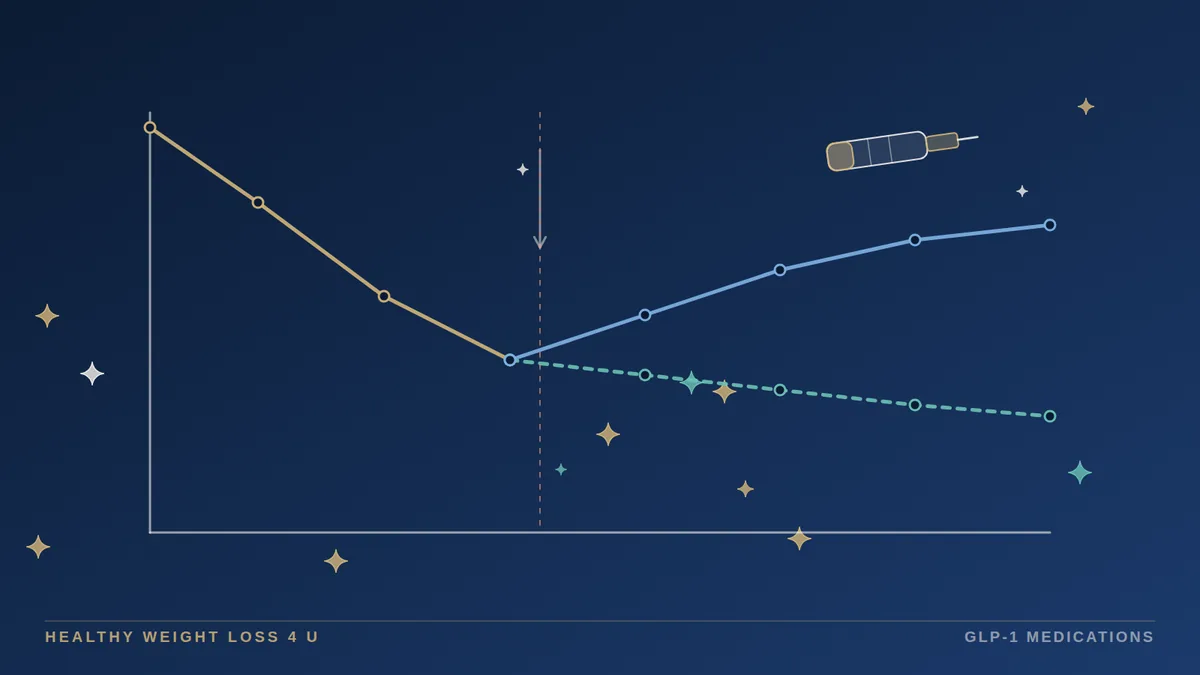
In randomized trials, people who stopped semaglutide or tirzepatide regained a large share of lost weight within a year: +6.9% (STEP 4, semaglutide) and +14.0% (SURMOUNT-4, tirzepatide) of body weight, versus continued weight loss in those who stayed on treatment [2][3]. One year after stopping semaglutide and lifestyle support in the STEP 1 extension, participants regained about two-thirds of their prior loss, and health markers mostly returned toward baseline [1]. The Obesity Society and Endocrine Society treat obesity as a chronic disease for which regain is expected when treatment ends [6][7].
Key takeaways
- STEP 4: weeks 20 to 68 weight change was -7.9% with continued semaglutide versus +6.9% after switching to placebo [2].
- SURMOUNT-4: weeks 36 to 88 weight change was -5.5% with continued tirzepatide versus +14.0% with placebo after a 20.9% lead-in loss [3].
- STEP 1 extension: after stopping semaglutide and lifestyle support, participants regained 11.6 percentage points, about two-thirds of their prior loss, in one year [1].
- A 2026 BMJ meta-analysis of 37 studies found regain averaged 0.4 kg per month after stopping weight-management medicines, and faster after semaglutide and tirzepatide [5].
- Continuing treatment, including at a reduced tirzepatide dose, maintained more loss than placebo in SURMOUNT-MAINTAIN [4].
- Whether nutrition and lifestyle programs alone can limit regain after stopping GLP-1 medicines has not been studied in controlled trials [10].
How much weight do people regain after stopping a GLP-1 medicine?
In randomized withdrawal trials, most participants regained a substantial share of lost weight within a year of stopping, while those who continued treatment kept losing or held steady. Individual results vary, and the figures below are published trial averages for specific populations, not predictions for any one person.
In STEP 4, 803 adults without diabetes completed a 20-week semaglutide run-in (mean weight loss 10.6%) and were randomized to continue semaglutide 2.4 mg or switch to placebo for 48 weeks, both with lifestyle intervention. From week 20 to week 68, body weight changed by -7.9% with continued semaglutide and +6.9% with placebo, a difference of 14.8 percentage points [2].
In SURMOUNT-4, 670 adults completed a 36-week tirzepatide lead-in (mean loss 20.9%) and were randomized to continue tirzepatide or switch to placebo for 52 weeks. From week 36 to week 88, weight changed by -5.5% with tirzepatide and +14.0% with placebo. Overall change from week 0 to week 88 was -25.3% with tirzepatide and -9.9% with placebo. At week 88, 89.5% of those continuing tirzepatide kept at least 80% of their lead-in loss versus 16.6% of those switched to placebo [3].
The STEP 1 extension followed 327 participants for one year after all treatment, including lifestyle intervention, stopped at week 68. In this subset, mean loss at week 68 was 17.3% with semaglutide and 2.0% with placebo. By week 120, semaglutide participants had regained 11.6 percentage points (placebo 1.9), leaving a net loss of 5.6% from baseline versus 0.1% with placebo [1]. The authors described this as regaining about two-thirds of prior weight loss; all extension analyses were exploratory [1].
The designs answer slightly different questions. STEP 4 and SURMOUNT-4 are randomized withdrawal trials: everyone first received the drug, and only those who tolerated it were randomized to continue or stop, so the results apply to people who responded to and tolerated treatment [2][3]. The STEP 1 extension had no continuation arm and followed people after both drug and lifestyle support ended, so it shows the course after a full stop rather than a comparison [1]. Because the lead-in losses differ (10.6% in STEP 4, 20.9% in SURMOUNT-4), the regain percentages are not directly comparable across drugs [2][3].
| Trial | Population and design | Continued treatment | Stopped or placebo |
|---|---|---|---|
| STEP 4 (semaglutide 2.4 mg) [2] | 803 adults, no diabetes; 20-week run-in, then 48 weeks randomized | -7.9% (weeks 20 to 68) | +6.9% (weeks 20 to 68) |
| SURMOUNT-4 (tirzepatide) [3] | 670 adults, no diabetes; 36-week lead-in, then 52 weeks randomized | -5.5% (weeks 36 to 88) | +14.0% (weeks 36 to 88) |
| STEP 1 extension (semaglutide 2.4 mg) [1] | 327 participants; all treatment and lifestyle support stopped at week 68; 52 weeks off treatment | Not applicable (no continuation arm) | +11.6 percentage points regained by week 120; net -5.6% from baseline |
| SURMOUNT-MAINTAIN (tirzepatide) [4][13] | 378 adults randomized after 60 weeks open-label; 52-week maintenance | -21.9% from baseline (maximum tolerated dose); -16.6% (5 mg) | -9.9% from baseline (placebo) |
Source: [3] Aronne et al., JAMA 2024
Do health markers also reverse after stopping?
Yes, in the trials that measured them, improvements in blood pressure and metabolic markers largely moved back toward baseline as weight returned. In STEP 4, continuing semaglutide produced a waist circumference 9.7 cm smaller and systolic blood pressure 3.9 mm Hg lower than switching to placebo [2]. In the STEP 1 extension, cardiometabolic improvements seen with semaglutide by week 68 mostly returned toward baseline by week 120 [1].
A 2026 BMJ systematic review and meta-analysis pooled 37 studies (9,341 participants) of weight-management medicines. It found an average regain of 0.4 kg per month after stopping, 0.8 kg per month for semaglutide and tirzepatide, and a projected return to baseline weight at about 1.5 years for those two drugs, with 9.9 kg regained in the first year [5]. All cardiometabolic markers were projected to return to baseline within 1.4 years, with systolic blood pressure rising about 0.5 mm Hg per month after cessation [5].
Two limits apply. Only one included study followed participants beyond one year, so long-term figures rely on modeling, and the newer drugs had no follow-up beyond 52 weeks, so their return-to-baseline estimates are extrapolated [5]. The authors rated certainty for the regain rate as moderate [5].
Why is obesity considered a chronic disease?
Major medical societies classify obesity as a chronic disease because weight and its health effects tend to return when treatment stops, as in the trials above. The Obesity Society's stated position is that obesity is a chronic disease [7], and its president has said that chronic diseases require long-term solutions [8].
The Endocrine Society's March 2026 scientific statement says that because obesity is a chronic disease, weight regain is expected once treatment ends. It describes obesity as a chronic, progressive disease that requires long-term treatment, cites STEP 4, the STEP 1 extension and SURMOUNT-4 as showing regain after stopping (in STEP 4, to a stabilized weight below baseline), and says regain varies widely between individuals [6]. It also observes that regulators require 52 weeks on a given dose for trials, which leaves the maintenance phase largely unstudied [6].
A 2025 Lancet Diabetes and Endocrinology Commission of 58 experts defined clinical obesity as a chronic, systemic illness, and stated that remission, in which all signs and symptoms of dysfunction resolve for at least 6 months, may return a person to pre-clinical obesity and is not a cure [12]. The Obesity Society welcomed the work as an important first step while cautioning that terms such as clinical and preclinical obesity may be confusing [7].
The current Wegovy prescribing information reflects this framing: it is indicated to reduce excess weight and maintain weight reduction long term in adults and pediatric patients 12 years and older with obesity [11].
What helps maintain weight loss?
The best-evidenced strategy in these trials is continuing treatment, and a newer trial tested whether a lower tirzepatide dose can work. In SURMOUNT-MAINTAIN, published in The Lancet in 2026, 378 adults who had lost at least 5% on tirzepatide during a 60-week open-label period were randomized to the maximum tolerated dose (10 or 15 mg), 5 mg, or placebo for 52 weeks. Weight change from baseline at week 112 was -21.9%, -16.6% and -9.9%, and 8%, 25% and 67% of participants regained at least 50% of their lost weight, the threshold at which rescue tirzepatide was allowed [4][13]. The figures are taken from the American College of Cardiology's summary of the article [13], and dose decisions remain a clinician's.
Exercise adds to medication for maintenance. In a Danish randomized trial, 195 adults lost a mean 13.1 kg on a low-calorie diet and were randomized for one year. Compared with placebo, body weight changed by -4.1 kg with exercise, -6.8 kg with liraglutide and -9.5 kg with both; the combination beat exercise alone (-5.4 kg) but not liraglutide alone to a statistically significant degree (-2.7 kg) [9]. Only the combination improved glycated hemoglobin, insulin sensitivity and cardiorespiratory fitness [9]. This trial used liraglutide, an older GLP-1 medicine, and a diet-induced starting loss.
The BMJ meta-analysis found weight regain was faster after stopping weight-management medicines than after stopping behavioral weight-management programs, by 0.3 kg per month [5]. The 2025 joint advisory from lifestyle, nutrition and obesity medicine societies states that whether structured nutrition and lifestyle therapy can limit weight regain after stopping GLP-1 medicines has not been studied in controlled trials [10]. No trial reviewed here tested a planned taper.
Continuing treatment has trade-offs as well as benefits. In STEP 4, gastrointestinal events occurred in 49.1% of the continued-semaglutide group versus 26.1% of the placebo group, while discontinuation because of adverse events was similar (2.4% versus 2.2%) [2]. In SURMOUNT-4, gastrointestinal events were more common with tirzepatide and mostly mild to moderate [3]. Side effects, cost and access are among the reasons people stop, which is why a plan for the period after stopping matters as much as the decision itself.
What is uncertain about these results?
Several limits affect how far the numbers travel.
- The withdrawal trials stopped drug and, in the STEP 1 extension, also stopped lifestyle support, so they do not show what happens with a planned transition to nutrition and activity programs [1][10].
- The STEP 1 extension involved a subset of 327 of 1,961 participants and its analyses were exploratory [1].
- Regain varies between individuals, and trial averages cannot predict an individual's course [6].
- Beyond one year of follow-up, estimates for semaglutide and tirzepatide are modeled, not observed [5].
- Trial populations were adults without diabetes who met BMI criteria; in STEP 4, for example, the mean age was 46 and 79% were women, so results may differ for other groups [2][3].
What this means in practice
Treat the decision to stop as a clinical one, planned in advance. Reasons to stop vary, including side effects, cost, pregnancy planning or reaching a goal, and each calls for a different plan. The Wegovy label, for example, directs discontinuation at least 2 months before a planned pregnancy [11]. Ask your clinician what monitoring, nutrition support and activity plan should accompany a stop or a dose change, because the trials above show weight and health markers tend to drift back when treatment ends.
At Healthy Weight Loss 4 U, the Lighthouse Point, FL and Highlands Ranch, CO clinics offer semaglutide and tirzepatide programs alongside maintenance, counseling, meal replacements and body composition analysis, and every program begins with a clinician evaluation. Maintenance planning is part of that conversation, including what support to put in place if you decide to stop. This article does not promise any weight outcome; results depend on individual evaluation and treatment.
When should you talk to a clinician?
Contact your prescribing clinician before stopping or changing a GLP-1 medicine, and sooner in these situations:
- You are considering stopping because of side effects, which may be manageable with other adjustments; see the companion article on managing GLP-1 side effects.
- You are planning a pregnancy, because the Wegovy label directs stopping at least 2 months beforehand [11].
- You have type 2 diabetes or high blood pressure and are on other medicines, because glucose and blood pressure may rise after stopping [1][5].
- You notice rapid weight regain after a stop, so that a plan can be reassessed rather than waiting.
Frequently asked questions
How quickly do you gain weight back after stopping semaglutide?
Do you regain weight after stopping tirzepatide?
Does obesity come back after treatment stops?
Do blood pressure and blood sugar get worse after stopping a GLP-1?
Can a lower dose maintain weight loss?
Can diet and exercise prevent regain after stopping a GLP-1 medicine?
Sources
- Weight regain and cardiometabolic effects after withdrawal of semaglutide: The STEP 1 trial extension. Diabetes, Obesity and Metabolism 24(8):1553-1564 (Wilding et al.), 2022. doi.org/10.1111/dom.14725
- Effect of Continued Weekly Subcutaneous Semaglutide vs Placebo on Weight Loss Maintenance in Adults With Overweight or Obesity: The STEP 4 Randomized Clinical Trial. JAMA 325(14):1414-1425 (Rubino et al.), 2021. doi.org/10.1001/jama.2021.3224
- Continued Treatment With Tirzepatide for Maintenance of Weight Reduction in Adults With Obesity: The SURMOUNT-4 Randomized Clinical Trial. JAMA 331(1):38-48 (Aronne et al.), 2024. jamanetwork.com/journals/jama/fullarticle/2812936
- Tirzepatide for maintenance of bodyweight reduction in people with obesity in the USA (SURMOUNT-MAINTAIN): a multicentre, double-blind, randomised, placebo-controlled trial. The Lancet 407(10545):2305-2318 (Horn et al.), 2026. doi.org/10.1016/S0140-6736(26)00656-2
- Weight regain after cessation of medication for weight management: systematic review and meta-analysis. The BMJ 392:e085304 (West et al.), 2026. bmj.com/content/392/bmj-2025-085304
- Obesity Science, Research Gaps and Opportunities in the New Era of Obesity Medicines (Scientific Statement). Endocrine Society, 2026. endocrine.org/-/media/endocrine/files/advocacy/position-statement/endo
- The Obesity Society Applauds the Work of The Lancet Diabetes & Endocrinology Commission on Diagnostic Criteria of Clinical Obesity. The Obesity Society, 2025. obesity.org/the-obesity-society-applauds-the-work-of-the-lancet-diabet
- The Obesity Society Applauds Medicare GLP-1 Bridge Program While Calling for Long-Term, Comprehensive Obesity Care. The Obesity Society, 2026. obesity.org/tos-applauds-medicare-glp1-bridge-program/
- Healthy Weight Loss Maintenance with Exercise, Liraglutide, or Both Combined. N Engl J Med 384(18):1719-1730 (Lundgren et al.), 2021. research.regionh.dk/en/publications/healthy-weight-loss-maintenance-wi
- Nutritional Priorities to Support GLP-1 Therapy for Obesity: A Joint Advisory From the ACLM, ASN, OMA and The Obesity Society. American Journal of Lifestyle Medicine (Mozaffarian et al.), 2025. pmc.ncbi.nlm.nih.gov/articles/PMC12125019/
- WEGOVY (semaglutide) injection and tablets: Prescribing Information (revised 06/2026). Novo Nordisk, 2026. novo-pi.com/wegovy.pdf
- Distilled: Lancet Diabetes & Endocrinology Commission on the definition and diagnostic criteria of clinical obesity (secondary summary of Rubino et al.). Diabetes on the Net, 2025. diabetesonthenet.com/wp-content/uploads/3.-Distilled_LDE-Commission-ob
- SURMOUNT-MAINTAIN: Continuing Tirzepatide Maintains Weight Loss (journal scan of Horn et al., The Lancet, 2026). American College of Cardiology, 2026. acc.org/Latest-in-Cardiology/Journal-Scans/2026/05/18/18/10/SURMOUNT-M
Keep reading
How GLP-1 Medications Work for Weight Loss
Read →Semaglutide vs Tirzepatide: What the Trials Show
Read →Metabolic Adaptation and Weight Loss Plateaus Explained
Read →Health Benefits of 5 to 15 Percent Weight Loss
Read →Questions about your own situation? A clinician can review your history and goals. Related: Weight Loss Maintenance Program.