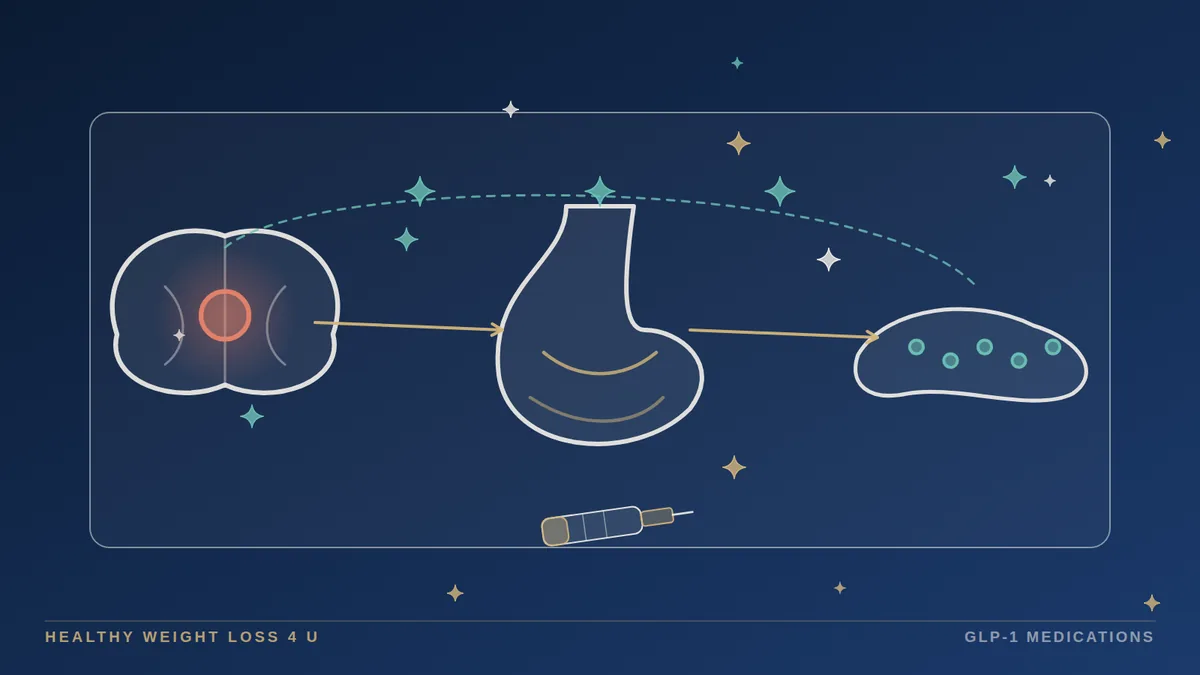
GLP-1 medications such as semaglutide (Wegovy) mimic a gut hormone that acts on appetite-regulating areas of the brain, slows stomach emptying and raises insulin only when blood sugar is high. Tirzepatide (Zepbound) also activates the GIP receptor. According to the FDA labels, the main weight effect is lower calorie intake, likely through reduced appetite, and they are approved as an add-on to diet and physical activity, not a replacement for them.
Key takeaways
- Semaglutide activates the GLP-1 receptor; tirzepatide activates both the GIP and GLP-1 receptors.
- Per the FDA labels, both drugs lower calorie intake, and the effect is likely mediated through appetite.
- Stomach emptying slows most after the first dose and the effect diminishes over time, per the Zepbound label.
- Insulin release rises only when blood glucose is elevated, and glucagon release falls.
- These medications are labeled as an adjunct to diet and activity, and weight is probably regained after stopping.
- A licensed clinician decides whether a GLP-1 medication is appropriate after an evaluation.
What are GLP-1 and GIP/GLP-1 medications?
They are injectable (and, for semaglutide, tablet) prescription medicines that copy the action of hormones released by the gut after eating. Semaglutide (brand name Wegovy) is a GLP-1 receptor agonist, and tirzepatide (brand name Zepbound) activates both the GIP receptor and the GLP-1 receptor [1][2].
GLP-1 and GIP are incretin hormones. After a meal they stimulate the pancreas to release insulin. The body's own versions are inactivated by an enzyme called dipeptidyl peptidase-4 (DPP-4) [4], while the drug versions resist that breakdown and have a longer half-life [5]. That durability is consistent with the once-weekly dosing described in the labels.
Both Wegovy and Zepbound are FDA-approved as an adjunct to a reduced-calorie diet and increased physical activity for chronic weight management in adults with obesity, or with overweight plus at least one weight-related condition [1][2]. NIDDK, part of the National Institutes of Health, states that these medicines do not replace physical activity or healthy eating and work best combined with a lifestyle program [3].
How do GLP-1 medications reduce appetite?
They activate receptors in brain regions involved in appetite regulation, and the net result in studies is lower calorie intake. The Wegovy label states that the GLP-1 receptor is present in several areas of the brain involved in appetite regulation, and both labels state that the drugs decrease calorie intake, an effect likely mediated by appetite [1][2].
For semaglutide, NIDDK describes the same mechanism in plain terms: the drug targets areas of the brain that regulate appetite and food intake [3]. A StatPearls review notes direct actions on the hypothalamus that increase satiety, meaning the feeling of fullness after eating [4]. A second StatPearls review of semaglutide adds that hypothalamic GLP-1 receptor activation may reduce hunger and food cravings [6].
Tirzepatide adds a second hormone pathway. The Zepbound label says nonclinical studies suggest that adding GIP receptor activation may further contribute to the regulation of food intake [1]. The wording matters: it describes a suggestion from nonclinical work, not a fully mapped human mechanism. A StatPearls review of tirzepatide likewise describes it as a dual GLP-1 and GIP agonist whose combined action is described as reducing appetite and lowering glucose more than GLP-1 agonists alone [7].
A limit to keep in mind is that much of the direct brain evidence comes from animal studies. The Zepbound label, for example, bases its brain statement on animal data showing that tirzepatide reaches and activates neurons in appetite-related regions [1]. What people notice in daily life, such as feeling full sooner, is consistent with that biology, but the labels do not claim that every person experiences the same degree of appetite change.
What do GLP-1 medications do to the stomach?
They slow gastric emptying, which is how quickly food leaves the stomach. According to the Zepbound label, the delay is largest after the first dose and diminishes over time [1]. The Wegovy label likewise states that semaglutide delays gastric emptying [2].
This slower emptying helps explain some common side effects, such as nausea and fullness, and it has three practical consequences that the labels address.
First, absorption of other oral medicines can change. Both labels advise caution or monitoring when oral medications are used with the drug. The Zepbound label specifically calls for monitoring patients on oral medications that depend on threshold concentrations for efficacy, and gives warfarin as an example of a narrow-therapeutic-index drug [1][2]. In a study of the tablet form of semaglutide, levothyroxine exposure rose by 33% [2].
Second, both labels carry a warning about pulmonary aspiration during general anesthesia or deep sedation, so anyone scheduled for a procedure should tell the anesthesia team and the prescriber that they take one of these medications [1][2].
Third, severe gastrointestinal reactions are a labeled risk. The Zepbound label reports severe gastrointestinal reactions in 1.7% (5 mg), 2.5% (10 mg) and 3.1% (15 mg) of patients versus 1% with placebo, and says the drug is not recommended in patients with severe gastroparesis, a condition of delayed stomach emptying [1]. The Wegovy label lists severe gastrointestinal adverse reactions among its warnings [2].
How do GLP-1 medications affect insulin and blood sugar?
They raise insulin release when blood glucose is high and lower glucagon release, so the glucose-lowering effect depends on glucose levels. The Wegovy label states that semaglutide stimulates insulin secretion and reduces glucagon secretion in a glucose-dependent manner, and the Zepbound label says the same for tirzepatide [1][2].
StatPearls explains that the drugs inhibit glucagon production from pancreatic alpha cells when blood sugar is high [4]. The Zepbound label notes that hypoglycemia risk is higher when it is combined with insulin or sulfonylureas [1]. In the Wegovy label, clinically significant hypoglycemia (below 54 mg/dL) in patients with type 2 diabetes occurred in 6.2% on semaglutide 2.4 mg versus 2.5% on placebo [2].
Tirzepatide is also described as increasing insulin sensitivity [1]. In the Zepbound label's trial in adults with type 2 diabetes and overweight or obesity, average hemoglobin A1c fell by 2.1 on both the 10 mg and 15 mg doses versus 0.5 on placebo over 72 weeks [1]. The Wegovy label instructs prescribers to monitor blood glucose before and during treatment in patients with diabetes [2].
The same active ingredients are also sold under different brand names for type 2 diabetes (Ozempic for semaglutide, Mounjaro for tirzepatide) [3]. The weight-management brands, Wegovy and Zepbound, are covered by their own labels.
Why can these medications be given once a week?
Their half-lives are long. The Zepbound label gives an elimination half-life of about 5 to 6 days for tirzepatide, and the Wegovy label gives about 1 week for semaglutide [1][2]. A StatPearls comparison reports a semaglutide half-life of roughly 5.7 to 6.7 days versus about 13 hours for daily liraglutide and a few hours for the earliest short-acting agents [5].
The long half-life has a consequence at the other end of treatment. According to the Wegovy label, semaglutide remains in circulation for about 5 to 7 weeks after the last injectable dose, and the label tells patients to discontinue at least 2 months before a planned pregnancy [2].
It also shapes how treatment starts. Both labels begin at a low dose and increase in steps over weeks, per the prescribing information [1][2]. In the SURMOUNT-1 trial of tirzepatide, most adverse events were gastrointestinal, mostly mild to moderate, and occurred mainly during dose escalation [8]. A licensed clinician sets the schedule for each patient.
| Feature | Semaglutide (Wegovy) | Tirzepatide (Zepbound) |
|---|---|---|
| Receptors activated | GLP-1 [2] | GIP and GLP-1 [1] |
| Appetite and intake | Decreases calorie intake; GLP-1 receptors present in brain areas involved in appetite regulation [2] | Decreases calorie intake, likely through appetite; animal studies show it reaches appetite-related neurons [1] |
| Stomach emptying | Delays gastric emptying [2] | Delays gastric emptying; largest after the first dose and diminishes over time [1] |
| Insulin and glucagon | Glucose-dependent insulin secretion; reduces glucagon [2] | Glucose-dependent insulin secretion; reduces glucagon; increases insulin sensitivity [1] |
| Body composition | Not covered in this comparison | Greater fat mass loss than lean mass loss [1] |
| Elimination half-life | About 1 week [2] | About 5 to 6 days [1] |
How much weight change do the trials show, and does everyone respond?
In published trials the average change is large, but individual results vary. In SURMOUNT-1, a 72-week, double-blind trial of 2,539 adults with obesity or overweight and no diabetes, mean weight change was -15.0% on tirzepatide 5 mg, -19.5% on 10 mg and -20.9% on 15 mg, versus -3.1% on placebo [1][8]. In STEP 1, a 68-week trial of 1,961 adults without diabetes, semaglutide 2.4 mg produced a mean change of -14.9% versus -2.4% on placebo [9]. These figures describe trial participants who also received lifestyle support, and they are not predictions for any individual.
The share who lose at least 5% of body weight is high but not universal. In the Zepbound label's SURMOUNT-1 data, 85.1% (5 mg), 88.9% (10 mg) and 90.9% (15 mg) reached at least 5% weight loss, versus 34.5% on placebo [1]. By simple subtraction, roughly 9% to 15% of tirzepatide participants did not reach that threshold.
NIDDK summarizes the class: after one year, adults taking a prescription weight-loss medication plus a lifestyle program lose about 3% to 12% more of their starting body weight than those making lifestyle changes alone, most of the loss occurs in the first 6 months, and a provider will probably advise stopping if at least 5% has not been lost after 12 weeks on the full dose [3].
What do GLP-1 medications not do?
They do not replace nutrition and activity, they do not guarantee a result, and their effect is not permanent once treatment stops.
- They are not a stand-alone treatment. The labels frame them as an adjunct to a reduced-calorie diet and increased physical activity [1], and NIDDK says medications do not replace healthy eating and activity [3].
- They do not remove only fat. The Zepbound label states weight loss comes with greater fat mass loss than lean mass loss, which means some lean mass is lost too [1].
- They do not work the same way for everyone, as the responder rates above show [1][3].
- They do not keep weight off after stopping. NIDDK states that people probably regain some weight after stopping, and that because obesity is chronic, a provider may advise staying on treatment long term if it helps and causes no serious side effects [3].
- They are not for everyone. Both are contraindicated with a personal or family history of medullary thyroid carcinoma or Multiple Endocrine Neoplasia syndrome type 2, and neither benefits weight loss during pregnancy [1][2].
- They should not be combined with other GLP-1 products. The Zepbound label states that coadministration with other tirzepatide products or any GLP-1 receptor agonist is not recommended [1].
What this means in practice
Understanding the mechanism sets realistic expectations. Appetite and fullness signals change first, and the stomach effect is strongest early [1]. In SURMOUNT-1, most gastrointestinal adverse events occurred mainly during dose escalation [8]. Eating patterns, protein intake, resistance activity and sleep still determine how much of the weight lost is fat versus lean tissue, a topic covered in our article on protecting muscle during weight loss.
Practical points drawn from the labels: tell every prescriber and the anesthesia team that you take a GLP-1 medication [1][2]; ask whether your other oral medicines need monitoring [1]; if you use insulin or a sulfonylurea, ask how your doses should be handled [1]; and if you use oral hormonal contraception and are prescribed tirzepatide, the Zepbound label advises switching to a non-oral method or adding a barrier method for 4 weeks after starting and after each dose escalation [1]. A licensed clinician decides all of this for the individual patient.
When to talk to a clinician: red flags
Contact a licensed clinician before starting if you or a close relative has had medullary thyroid carcinoma or MEN 2, if you are pregnant, planning pregnancy or breastfeeding, or if you have diabetes, kidney disease, gallbladder disease or a history of pancreatitis [1][2][3].
During treatment, seek prompt medical advice for symptoms the labels flag. The Zepbound label asks patients to report a mass in the neck, trouble swallowing, shortness of breath or persistent hoarseness, because thyroid C-cell tumors were seen in rodents and the human relevance is undetermined [1]. Both labels say to stop the drug and seek management if pancreatitis is suspected, and both warn that gastrointestinal reactions can cause dehydration leading to acute kidney injury [1][2]. Report any possible allergic reaction right away.
Frequently asked questions
How does semaglutide cause weight loss?
What is the difference between GLP-1 and GIP/GLP-1 medications?
Do GLP-1 medications slow digestion permanently?
Do GLP-1 medications work without diet and exercise changes?
Why does weight come back after stopping a GLP-1 medication?
Who should not take a GLP-1 medication?
Sources
- ZEPBOUND (tirzepatide) injection: Full Prescribing Information (revised 8/2026). Eli Lilly and Company, 2026. uspl.lilly.com/zepbound/zepbound.html
- WEGOVY (semaglutide) injection and tablets: Full Prescribing Information (revised 06/2026). Novo Nordisk, 2026. novo-pi.com/wegovy.pdf
- Prescription Medications to Treat Overweight & Obesity. National Institute of Diabetes and Digestive and Kidney Diseases (NIDDK), NIH, 2024. niddk.nih.gov/health-information/weight-management/prescription-medica
- Glucagon-Like Peptide-1 Receptor Agonists (StatPearls). NCBI Bookshelf, National Library of Medicine, 2024. ncbi.nlm.nih.gov/books/NBK551568/
- Compare and Contrast the Glucagon-Like Peptide-1 Receptor Agonists (GLP1RAs) (StatPearls). NCBI Bookshelf, National Library of Medicine, 2024. ncbi.nlm.nih.gov/books/NBK572151/
- Semaglutide (StatPearls). NCBI Bookshelf, National Library of Medicine, 2024. ncbi.nlm.nih.gov/books/NBK603723/
- Tirzepatide (StatPearls). NCBI Bookshelf, National Library of Medicine, 2024. ncbi.nlm.nih.gov/books/NBK585056/
- Tirzepatide Once Weekly for the Treatment of Obesity (SURMOUNT-1), N Engl J Med 2022;387:205-216. The New England Journal of Medicine, 2022. doi.org/10.1056/NEJMoa2206038
- Once-Weekly Semaglutide in Adults with Overweight or Obesity (STEP 1), N Engl J Med 2021;384:989-1002. The New England Journal of Medicine, 2021. doi.org/10.1056/NEJMoa2032183
Keep reading
Semaglutide vs Tirzepatide: What the Trials Show
Read →First 12 Weeks on a GLP-1: What to Expect, Per the Labels
Read →Managing GLP-1 Side Effects: Nausea, Reflux, Red Flags
Read →Weight Regain After Stopping GLP-1: What the Trials Show
Read →Questions about your own situation? A clinician can review your history and goals. Related: Semaglutide Weight Loss, Tirzepatide Weight Loss.