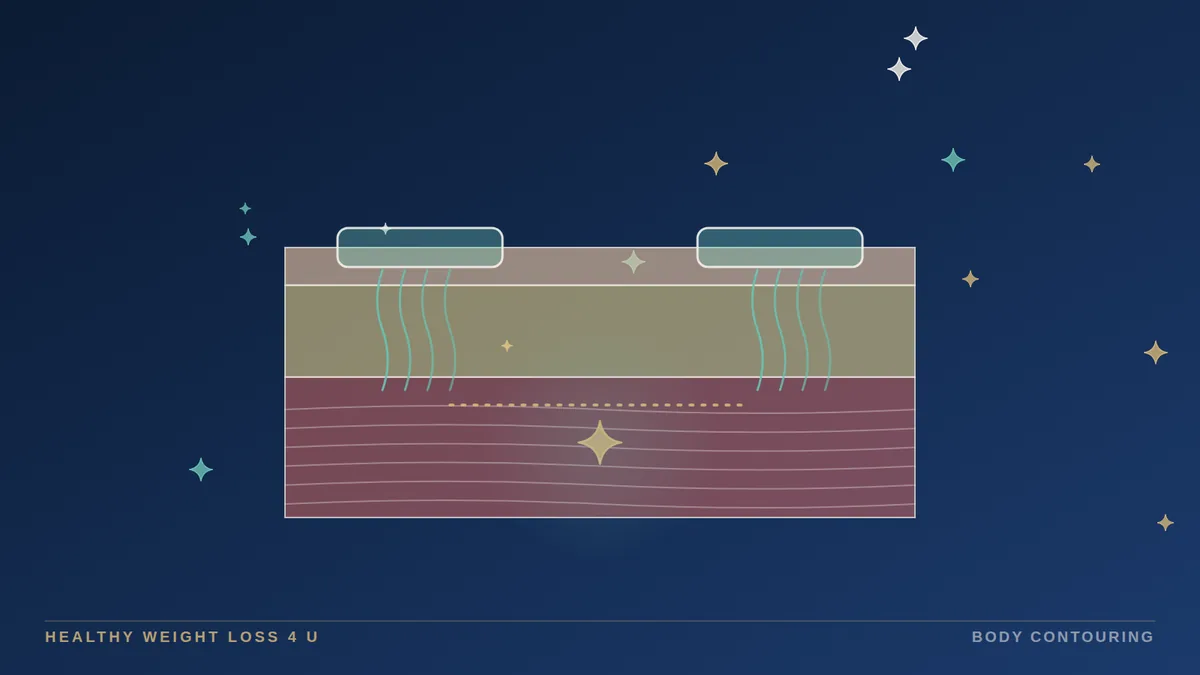
truSculpt flex is an electrical muscle stimulation (EMS) device. Its FDA 510(k) record states it is indicated for improvement of abdominal tone, strengthening of the abdominal muscles, development of a firmer abdomen, and strengthening, toning and firming of the buttocks and thighs. That wording does not include fat reduction or weight loss. Contraindications listed by the manufacturer include pacemakers, defibrillators, implanted electronic devices, metal implants under the treatment area, epilepsy and pregnancy without physician evaluation.
Key takeaways
- The cleared wording covers abdominal tone and strength, and toning and firming of the buttocks and thighs, with no fat-reduction or weight-loss claim [1].
- truSculpt flex is an electrical muscle stimulator regulated as a powered muscle stimulator, which the regulation defines as a device that repeatedly contracts muscles with electrical current [1][7].
- The FDA summary reports no clinical study; the best-documented study of an abdominal EMS belt in this review was a different, manufacturer-funded device [1][4].
- Pacemakers, defibrillators and other implanted electronic devices, metal implants under the area and pregnancy without physician evaluation are listed exclusions [2][6].
- EMS is different from the magnetic-field (HIFEM) devices, which the FDA describes separately [6].
What is truSculpt flex?
truSculpt flex is an electrical muscle stimulation (EMS) system that makes muscles contract through electrodes placed on the skin. The FDA record describes a console with a touchscreen and eight handpiece pairs applied with hydrogel pads and silicone belts, with four outputs and a symmetrical biphasic waveform in all three modes, which are named PREP, TONE and SCULPT. Listed treatment time is 45 minutes (Classic) or 15 minutes (flex+) [1].
Cutera, which markets the device, calls it a muscle-stimulating device with proprietary Multi-Directional Stimulation and three treatment options, and describes treatment as taking as little as 15 minutes [2][3]. The FDA record lists Johari Digital Healthcare Limited as the applicant and states that the device is manufactured for 7e Wellness Corporation [1]. The sources reviewed here do not describe the commercial relationship between that applicant and Cutera, so ask the Highlands Ranch clinic which clearance covers its unit.
The clinic lists truSculpt flex among its devices. The device is separate from truSculpt iD, an RF device that Cutera sells for fat-related uses. See the separate article on truSculpt iD.
What is truSculpt flex FDA-cleared to do?
The clearance wording covers muscle tone and strength in three areas and nothing else. The 510(k) (K212866, letter December 3, 2022) states that truSculpt flex is indicated to be used for improvement of abdominal tone, for strengthening of the abdominal muscles, for development of firmer abdomen, and for strengthening, toning and firming of buttocks and thighs [1]. Cutera's product page for the same device (which it calls truFlex) gives closely matching wording [2]. The product code is NGX, and the regulation is 21 CFR 890.5850, powered muscle stimulator, Class II [1].
The regulation defines a powered muscle stimulator as an electrically powered device intended for medical purposes that repeatedly contracts muscles by passing electrical currents through electrodes contacting the affected body area [7]. The primary predicate is Torc Body (K192039) [1]. The FDA record lists no clinical data, only non-clinical bench testing, and no contraindications [1]. Clearance is not approval: it means the FDA found the device substantially equivalent to a legally marketed predicate.
Fat reduction, weight loss, cellulite reduction and body shaping are not part of the cleared wording [1]. Cutera's product page for the device does not make an FDA-cleared claim of its own, and it lists contraindications and warnings [2]. The FDA's consumer page states that non-invasive body contouring does not treat obesity or improve your health and does not produce weight loss [6].
| Goal | In the FDA 510(k) wording? | Source |
|---|---|---|
| Improve abdominal tone, strengthen abdominal muscles, firmer abdomen | Yes | K212866 [1] |
| Strengthen, tone and firm buttocks and thighs | Yes | K212866 [1] |
| Fat reduction or fat loss | No | K212866 [1] |
| Weight loss | No (the FDA says contouring does not produce weight loss) | K212866, FDA page [1][6] |
How does electrical muscle stimulation work?
EMS sends small electrical pulses through the skin to nerves that trigger muscles to contract without a voluntary effort. In the FDA record, the SCULPT mode uses a modulated sine wave at 4000 Hz with a resultant 1 to 100 Hz stimulation, TONE uses a square wave at 99 Hz, and PREP uses a step sine wave, with maximum outputs of 100 Vpp and 200 mA at 500 ohms for PREP and SCULPT and 70 Vpp and 140 mA for TONE [1]. These are engineering specifications, not measures of results.
EMS is not the same technology as high-intensity focused electromagnetic (HIFEM) devices. The FDA describes magnetic-field devices as working by pulsed magnetic fields triggering a small electric current in the muscles, and lists their risks as muscle soreness and cramps [6]. truSculpt flex delivers current directly through skin electrodes [1].
What does the research show, and what are its limits?
For this specific device, no published clinical data were located in the sources available for this review. The FDA summary reports none [1], and Cutera's product page cites only operator manuals, and it quotes a provider as referring to a clinical study without naming authors, sample size or results [2]. Cutera gives before and after examples at four and six sessions and states no recommended number of sessions [2]. Those examples are manufacturer material and do not establish what an average person can expect.
The best-documented comparison found is a 2005 study of a different product, the Slendertone FLEX abdominal belt, published in the Journal of Sports Science and Medicine. It randomized volunteers aged 25 to 50 with a BMI of 18 to 30 to a stimulation group (24 analyzed) or a no-exercise control group (16). Stimulation sessions were self-administered five days a week for eight weeks, rising from 20 to 25 minutes to 40 minutes, with diet kept unchanged. Isometric abdominal strength rose 58% in the stimulation group versus no change in controls, abdominal circumference fell 2.6 cm versus no change, and body weight and skinfolds did not change significantly [4].
This study has several limits for anyone considering truSculpt flex. It tested a different device and a home-style belt protocol rather than a clinic protocol. The manufacturer, Compex Technologies, funded the study and supplied the belts. The control group was not given any exercise, so the study cannot show that stimulation beats ordinary abdominal exercise. The groups differed in age at baseline, outcomes included participants' own reports of a firmer midsection, body fat was assessed by skinfold thickness, and follow-up ended at eight weeks [4]. The authors themselves noted the bias risk of manufacturer-run studies [4].
The strongest reasonable reading is that EMS can contract muscles and, in one small manufacturer-funded trial of a different device, was associated with greater abdominal strength over eight weeks of near-daily use. It does not show a durable change in appearance, fat or weight from truSculpt flex. The FDA says that results of many procedures are temporary and may require ongoing treatment [6].
Context on marketing claims also matters. In 2002 the U.S. Federal Trade Commission filed complaints against the marketers of three electronic abdominal belt products alleging false claims that the devices cause fat and inch loss, give well-defined abdominal muscles without exercise, and work as well as sit-ups, and that they were safe for all users. The FTC noted these were allegations and not court findings [5].
What does treatment involve?
The FDA record lists 15-minute (flex+) and 45-minute (Classic) treatment times, and Cutera describes a treatment of as little as 15 minutes [1][2]. Neither source gives a required number of sessions, spacing, results timeline or downtime [1][2]. The manufacturer says discomfort, tenderness and muscle soreness may persist for a few hours after treatment, potentially extending to a few days [2]. The treating clinician sets the plan.
Cutera lists burns beneath the electrodes among reported effects of powered muscle stimulators, along with increased heart rate, skin irritation, tingling, bruising and random muscle contraction [2]. Its safety text instructs staff to keep verbal contact with the patient during therapy and never to leave the patient unattended [2]. The FDA lists muscle soreness and cramps as risks of magnetic-field muscle devices [6].
Who is a reasonable candidate, and who should not have it?
A reasonable candidate is a healthy adult who wants stimulation-assisted toning of the abdomen, buttocks or thighs, understands that fat and weight are not part of the cleared wording, and has none of the exclusions below. The sources reviewed do not show that muscle stimulation replaces resistance training or adequate protein, which are covered in the related article on protecting muscle during weight loss.
Cutera lists these contraindications: cardiac pacemakers, defibrillators or other implanted electronic devices; metallic implants under the treatment area; epilepsy; cancerous lesions; acute trauma or fracture; recent surgical procedures; abdominal or inguinal hernia; critical ischemia of the lower limbs; and blood flow deficiencies or venous thrombosis [2]. Its warnings include not treating pregnant patients without physician evaluation, not treating the eye area, not treating transthoracically (across the chest), and not treating over metal implants [2]. The FDA's consumer page separately says people with active implants such as pacemakers or defibrillators, and people with metal under the skin from an implant or injury, should avoid muscle-stimulating magnetic devices [6]. The 2005 belt study excluded people with pacemakers, abdominal implants or recent pregnancy [4].
- Pacemaker, defibrillator or other implanted electronic device
- Metal implant under the treatment area
- Pregnancy (manufacturer: not without physician evaluation)
- Epilepsy, cancer in the area, recent surgery, fracture or acute trauma
- Abdominal or inguinal hernia
- Blood clot or circulation problems in the legs
What this means in practice
Think of truSculpt flex as a tool for muscle conditioning, evaluated on strength and tone rather than weight or fat. A useful consultation sets one measurable goal, such as a repeat measurement under the same conditions, and agrees what counts as success. If a provider describes it as burning fat or replacing exercise, ask which cleared indication supports that statement, because the FDA wording does not include it. For people losing weight on medication, protecting lean mass through protein and resistance exercise remains the evidence-based foundation.
When to talk to a clinician
Healthy Weight Loss 4 U programs begin with a clinician evaluation. Tell the clinician before treatment about any implanted device, metal, hernia, seizure history, blood clots or pregnancy. Contact the clinic promptly after a session for burns or blisters under the electrodes, severe or worsening pain, chest discomfort or a racing heart [2].
Questions to ask your provider
Bring these to a consultation.
- Which clearance covers this unit, and where can I see it?
- What outcome is the treatment meant to change: strength, tone or appearance, and how will we measure it?
- What evidence supports this device specifically, and who funded it?
- How many sessions do you plan, and what is the follow-up if I see no change?
- Do any of the listed contraindications apply to me, including implants, hernia or pregnancy?
- How does this fit alongside my protein intake and strength training?
Frequently asked questions
Is truSculpt flex FDA-cleared?
Does truSculpt flex burn fat?
Is muscle stimulation the same as EmSculpt or HIFEM?
Who should not have muscle stimulation treatment?
How many truSculpt flex sessions are needed?
What are the side effects of electrical muscle stimulation?
Sources
- 510(k) K212866: truSculpt flex (summary and indications for use). U.S. FDA, Center for Devices and Radiological Health, 2022. accessdata.fda.gov/cdrh_docs/pdf21/K212866.pdf
- truFlex product page (indications, contraindications, warnings). Cutera (manufacturer), n.d.. cutera.com/us-en/products/truflex/
- Body sculpting solutions. Cutera (manufacturer), n.d.. cutera.com/us-en/treatments/body-sculpting-solutions/
- The effects of neuromuscular stimulation training on abdominal strength, endurance and selected anthropometric measures (Porcari et al.). Journal of Sports Science and Medicine 4:66-75, 2005. jssm.org/hf.php?id=jssm-04-66.xml
- FTC Charges Three Top-Selling Electronic Abdominal Exercise Belts with Making False Claims. U.S. Federal Trade Commission, 2002. ftc.gov/opa/2002/05/projectabsurd.htm
- Non-Invasive Body Contouring Technologies. U.S. Food and Drug Administration, 2025. fda.gov/medical-devices/aesthetic-cosmetic-devices/non-invasive-body-c
- 21 CFR 890.5850 Powered muscle stimulator. Code of Federal Regulations (text via Cornell Legal Information Institute), n.d.. law.cornell.edu/cfr/text/21/890.5850
Keep reading
truSculpt iD RF Body Contouring: What It Is Cleared For
Read →Protect Muscle During Weight Loss: What the Evidence Shows
Read →Body Composition Analysis: Why the Scale Misleads You
Read →Body Contouring vs Weight Loss: Who Is a Candidate?
Read →Questions about your own situation? A clinician can review your history and goals. Related: truSculpt, truFlex and EMTONE Contouring.