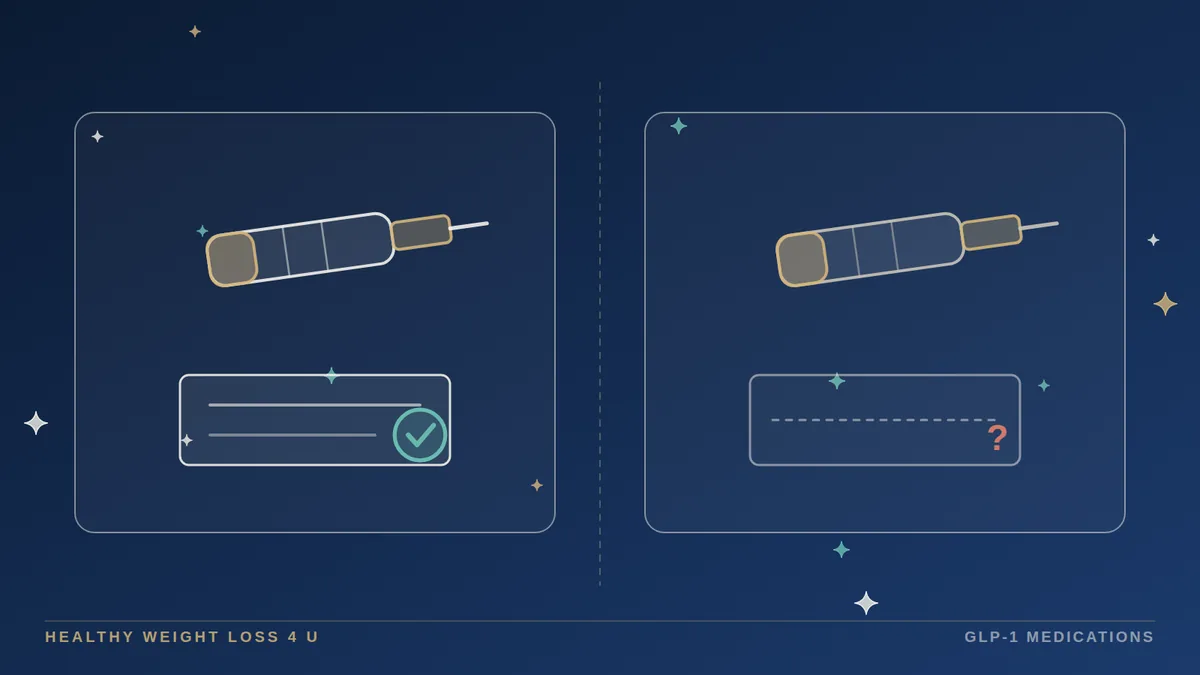
Wegovy (semaglutide) and Zepbound (tirzepatide) are FDA-approved; compounded semaglutide and tirzepatide are not, and the FDA does not review them for safety, effectiveness or quality before they are marketed. The FDA declared the tirzepatide shortage resolved on October 2, 2024 (reaffirmed December 19, 2024) and the semaglutide shortage resolved on February 21, 2025, and the enforcement grace periods that followed have ended. The FDA says compounded drugs should only be used when a patient's medical needs cannot be met by an FDA-approved drug.
Key takeaways
- Brand-name Wegovy and Zepbound are FDA-approved; compounded versions are not, and FDA does not review them for safety, effectiveness or quality.
- FDA resolved the tirzepatide shortage (10/02/2024, reaffirmed 12/19/2024) and the semaglutide shortage (02/21/2025); as of 04/01/2026 neither is on the shortage list.
- Section 503A pharmacies and Section 503B outsourcing facilities follow different rules, and FDA limits compounded 'essentially copies' of approved drugs.
- FDA has received reports of adverse events, some requiring hospitalization, tied to dosing errors with compounded injectable semaglutide.
- Patients can ask which product they are being prescribed, who makes it, how to measure the dose, and how to report problems.
What is the difference between brand-name and compounded semaglutide and tirzepatide?
Brand-name Wegovy and Zepbound are FDA-approved drugs; compounded semaglutide and tirzepatide are not. The FDA states that compounded drugs are not FDA-approved and that it does not verify their safety, effectiveness or quality before they are marketed [8]. On its GLP-1 safety page the FDA adds that unapproved versions do not undergo its review for safety, effectiveness and quality before they are marketed [1].
Compounding means creating a medication tailored to the needs of an individual patient [8]. It happens in two settings. Section 503A covers licensed pharmacists in a state-licensed pharmacy or federal facility, or physicians. These drugs are not subject to current good manufacturing practice (CGMP) requirements, and state boards of pharmacy have primary day-to-day oversight, with FDA conducting surveillance and for-cause inspections [8]. Section 503B covers outsourcing facilities, which were established in 2013 by the Drug Quality and Security Act, register with FDA, are primarily overseen by FDA, are subject to CGMP, and are inspected on a risk-based schedule [8].
The prescribing information for the approved products, including the boxed warning for thyroid C-cell tumors, is FDA-reviewed labeling [9][10]. The FDA does not review labeling or quality for compounded versions in the same way [1][8].
| Topic | FDA-approved (Wegovy, Zepbound) | Compounded semaglutide or tirzepatide |
|---|---|---|
| FDA review before marketing | Reviewed for safety, effectiveness and quality as approved drugs [1] | Not FDA-approved; FDA does not review for safety, effectiveness or quality [1][8] |
| Where made | Marketed by the approved drug's manufacturer | 503A: state-licensed pharmacy, state board oversight, no CGMP requirement. 503B: FDA-registered outsourcing facility, CGMP, FDA inspection [8] |
| Active ingredient | Semaglutide or tirzepatide as defined in the approved label [9][10] | FDA says semaglutide sodium and semaglutide acetate are different active ingredients from those in approved drugs and that it knows of no lawful basis for their use in compounding [1] |
| Adverse event reporting | Not addressed on the FDA pages reviewed | State-licensed pharmacies that are not outsourcing facilities are not required to report to FDA, so reports are likely undercounted [1] |
Are the semaglutide and tirzepatide shortages over?
Yes. FDA determined that the tirzepatide injection shortage was resolved on October 2, 2024, and issued a new decision on December 19, 2024 confirming the resolution after a court remanded the first decision. It determined the semaglutide injection shortage resolved on February 21, 2025 [2][3][4].
For tirzepatide, FDA's December 2024 memo covers Mounjaro and Zepbound, states that supply meets or exceeds demand, and notes that the shortage had been in effect since December 15, 2022 [3]. For semaglutide, the February 2025 order covers Ozempic and Wegovy pens and states that Novo Nordisk's data show supply meeting or exceeding demand [4]. In both cases FDA explained that patient reports, compounding volume and similar information did not outweigh manufacturer data, and attributed remaining local access problems to distribution dynamics rather than a national shortfall [3][4].
FDA gave compounders a limited transition period before enforcing the shortage-dependent conditions. Those periods have ended, and as of FDA's April 1, 2026 update neither drug is on the shortage list or the 503B bulks list [2].
| Date | Event |
|---|---|
| October 2, 2024 | FDA announces the tirzepatide shortage is resolved [2] |
| December 19, 2024 | FDA issues a new decision confirming the tirzepatide shortage is resolved, after litigation remanded the earlier decision [2][3] |
| February 21, 2025 | FDA determines the semaglutide shortage is resolved [2][4] |
| March 5, 2025 | Tirzepatide 503A transition period ends after a court denies a preliminary injunction [2] |
| March 19, 2025 | Tirzepatide 503B transition period ends [2] |
| April 24, 2025 | Semaglutide 503A transition period ends after a court denies a preliminary injunction [2] |
| May 22, 2025 | Semaglutide 503B transition period ends [2][4] |
| April 1, 2026 | FDA update: neither drug is on the shortage list or the 503B bulks list [2] |
What are the 503A and 503B rules for compounded GLP-1 drugs today?
Compounders may not routinely make copies of an approved drug. FDA's guidance, as summarized on its page, treats a compounded drug as essentially a copy if it has the same active ingredient as a commercially available product, in the same, similar or easily substitutable strength, and can be given by the same route, unless a prescriber documents a significant difference for a specific patient [2]. A combination of ingredients that each match commercially available products can also be considered a copy under similar conditions [2]. FDA's example is semaglutide plus vitamin B12, which may be a copy if each ingredient is within 10% of the commercial strength [2].
For 503A pharmacies, the drug must be compounded for an individual patient based on a prescription, and not regularly or in inordinate amounts as essentially copies [2]. FDA's April 1, 2026 update states that it does not intend to act against compounders who fill four or fewer prescriptions for an essentially-copy product per calendar month [2].
For 503B outsourcing facilities, bulk substances may be used only if they appear on the 503B bulks list or the compounded drug is on FDA's drug shortage list at the time of compounding, distribution and dispensing [2]. On April 30, 2026, FDA announced a proposal to exclude semaglutide, tirzepatide and liraglutide from the 503B bulks list, stating it found no clinical need for outsourcing facilities to compound them from bulk drug substances [6]. The Federal Register notice published May 1, 2026 explains that FDA does not treat shortages or backorders as clinical need [7]. The notice is a proposal. A June 26, 2026 notice extended the comment period to July 30, 2026 [11], and that extension was the most recent document in the Federal Register docket when we checked on October 8, 2026. We found no final determination, so the exclusion should be treated as proposed, not final.
In February 2026 FDA also said it intends to restrict GLP-1 active pharmaceutical ingredients used in non-approved compounded drugs and to act on misleading marketing. FDA said companies cannot claim that non-approved compounded products are generic versions of FDA-approved drugs, that they use the same active ingredient as approved drugs, or that they are clinically proven to produce results [5].
What safety concerns has the FDA raised about compounded GLP-1 drugs?
The FDA has highlighted dosing errors, adverse event reports, unverified ingredients and counterfeit or mislabeled products. According to its page updated October 1, 2026, FDA received multiple reports of adverse events, some requiring hospitalization, that may relate to dosing errors with compounded injectable semaglutide: patients sometimes measured doses incorrectly, and some clinicians miscalculated doses [1].
Some reports involved doses above the FDA-approved label, including larger single doses, more frequent dosing or faster titration. Some were serious, with symptoms such as nausea, vomiting, diarrhea, abdominal pain and constipation [1]. As of May 31, 2026, FDA had 990 adverse event reports for compounded semaglutide and more than 730 for compounded tirzepatide. FDA notes these are likely underreported and that it is not always possible to tell whether the drug caused an event [1].
FDA also cautions about product integrity. It is aware of counterfeit Ozempic marketed in the U.S. and has warned companies that sold products falsely labeled 'for research purposes' or 'not for human consumption.' Its telehealth red flags also include label spelling errors and a pharmacy name on the label that may be fraudulent. It states that retatrutide and cagrilintide cannot be used in compounding under federal law [1]. FDA created import alert 66-80 to help stop GLP-1 active ingredients with potential quality concerns [1].
When does the FDA say compounding may be appropriate?
The FDA says compounded drugs should only be used in patients whose medical needs cannot be met by an FDA-approved drug [1]. On its compounding page it gives examples: a patient who is allergic to a dye in an approved product; a patient who cannot swallow a tablet or capsule and needs a liquid form; and a drug on FDA's shortage list compounded under conditions set out in federal law [8].
That framework means the decision belongs to a licensed prescriber with a documented clinical reason, not to a marketing claim. FDA specifically lists as telehealth red flags statements that a compounded drug is the same as an FDA-approved drug, deep discounts, no licensed doctor screening, and label spelling errors [1]. This article does not recommend compounded products. It describes what the regulator has said.
What should patients ask about any GLP-1 product?
Ask which product is being prescribed, who made it, and how it is meant to be stored and measured. FDA advises getting a prescription from a doctor and filling it at a state-licensed pharmacy, and contacting the compounder or telehealth platform about instructions or label information [1].
- Is this an FDA-approved brand such as Wegovy or Zepbound, or a compounded preparation? If compounded, why can an FDA-approved drug not meet my needs? [1]
- Is the pharmacy state-licensed, and is it a 503A pharmacy or a 503B outsourcing facility? [1][8]
- What is the active ingredient exactly? FDA warns that semaglutide salt forms are different active ingredients from those in approved drugs [1].
- How is the dose measured and given (units, syringe, concentration)? FDA says patients should ask how to measure and give the intended dose [1].
- What dose and schedule does the prescriber intend, and how does it compare with the FDA-approved label? FDA reports adverse events involving doses above the label, including faster titration [1].
- How should the medication be stored? FDA says not to use any injectable GLP-1 drug that arrives warm or without enough refrigeration, and to discard multi-dose vials within 28 days of first use [1].
- Is a new, sterile needle and syringe used for every dose? FDA says always use one [1].
- How do I report a problem? FDA accepts adverse event and quality reports through MedWatch [1].
What this means in practice
Brand-name and compounded products are regulated differently, and the FDA's position is that approved drugs should be used whenever they can meet the patient's needs [1]. Cost, insurance coverage and access are real considerations for patients, and the shortage that once justified wider compounding has been resolved by FDA's determination [2][3][4]. A prescriber should be able to explain, in plain terms, which product they chose and why.
Whichever product is prescribed, the same basics apply: a clinician evaluation before starting, a dose plan that the prescriber explains, a way to reach the clinic if symptoms occur, and attention to the boxed warning and contraindications in the approved labels, which include a personal or family history of medullary thyroid carcinoma or Multiple Endocrine Neoplasia syndrome type 2 [9][10]. Our related articles explain how these medications work and what the first 12 weeks can look like.
When to talk to a clinician: red flags
Contact the prescriber promptly if you suspect a dosing error, such as injecting more than intended, or if you develop persistent nausea, vomiting, diarrhea, abdominal pain or constipation after a dose, since these are the symptoms FDA described in dosing-error reports [1]. Seek care for signs of dehydration or any serious allergic reaction, which approved labels flag as risks [9][10].
FDA recommends against using an injectable GLP-1 drug that arrives warm or with insufficient refrigeration, lists label spelling errors as a red flag, and has warned companies selling products falsely labeled 'for research purposes' [1]. Report problems to the FDA through MedWatch online or by fax to 1-800-FDA-0178 [1].
Frequently asked questions
Is compounded semaglutide FDA-approved?
Is the semaglutide or tirzepatide shortage over?
What is the difference between 503A and 503B compounders?
What are the FDA's main safety concerns with compounded GLP-1 drugs?
What should I ask before using a compounded GLP-1 product?
Does the FDA allow compounded GLP-1 drugs that copy Wegovy or Zepbound?
Sources
- FDA's Concerns with Unapproved GLP-1 Drugs Used for Weight Loss. U.S. Food and Drug Administration, 2026. fda.gov/drugs/postmarket-drug-safety-information-patients-and-provider
- FDA clarifies policies for compounders as national GLP-1 supply begins to stabilize. U.S. Food and Drug Administration, 2026. fda.gov/drugs/drug-alerts-and-statements/fda-clarifies-policies-compou
- Resolution of Tirzepatide Injection Product Shortage and Supply Status (FDA CDER memo, December 19, 2024). U.S. Food and Drug Administration, 2024. fda.gov/media/185577/download
- FDA declaratory order: resolution of semaglutide injection shortage (February 21, 2025). U.S. Food and Drug Administration, 2025. fda.gov/media/185526/download
- FDA Intends to Take Action Against Non-FDA-Approved GLP-1 Drugs. U.S. Food and Drug Administration, 2026. fda.gov/news-events/press-announcements/fda-intends-take-action-agains
- FDA Proposes to Exclude Semaglutide, Tirzepatide, and Liraglutide on 503B Bulks List. U.S. Food and Drug Administration, 2026. fda.gov/news-events/press-announcements/fda-proposes-exclude-semagluti
- List of Bulk Drug Substances for Which There Is a Clinical Need Under Section 503B of the Federal Food, Drug, and Cosmetic Act (91 FR 23431). Federal Register, U.S. Food and Drug Administration, 2026. federalregister.gov/documents/2026/05/01/2026-08552/list-of-bulk-drug-
- Compounding and the FDA: Questions and Answers. U.S. Food and Drug Administration, 2025. fda.gov/drugs/human-drug-compounding/compounding-and-fda-questions-and
- ZEPBOUND (tirzepatide) injection: Full Prescribing Information (revised 8/2026). Eli Lilly and Company, 2026. uspl.lilly.com/zepbound/zepbound.html
- WEGOVY (semaglutide) injection and tablets: Full Prescribing Information (revised 06/2026). Novo Nordisk, 2026. novo-pi.com/wegovy.pdf
- List of Bulk Drug Substances for Which There Is a Clinical Need Under Section 503B: extension of comment period (June 26, 2026). Federal Register, U.S. Food and Drug Administration, 2026. federalregister.gov/documents/2026/06/26/2026-12937/list-of-bulk-drug-
Keep reading
How GLP-1 Medications Work for Weight Loss
Read →Semaglutide vs Tirzepatide: What the Trials Show
Read →First 12 Weeks on a GLP-1: What to Expect, Per the Labels
Read →How to Choose a Medical Weight Loss Clinic: 12 Questions
Read →Questions about your own situation? A clinician can review your history and goals. Related: Semaglutide Weight Loss, Tirzepatide Weight Loss.