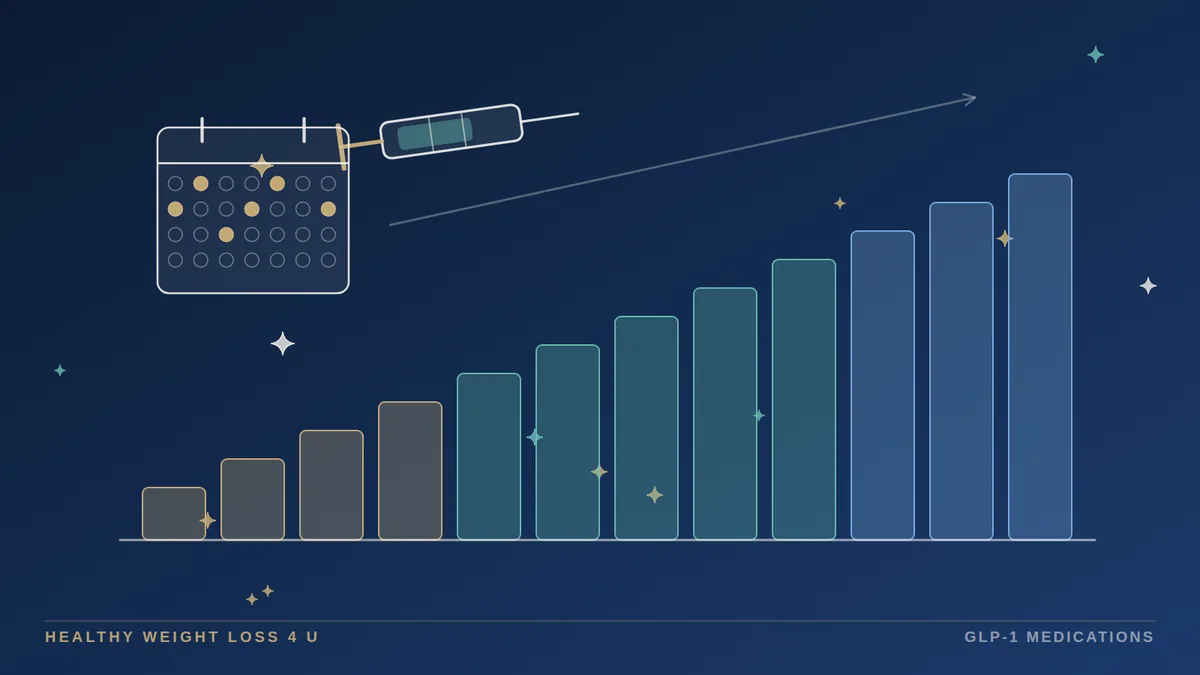
Per the prescribing information, both Wegovy and Zepbound start at a low weekly dose and increase in steps of at least 4 weeks, so the first 12 weeks are a dose-escalation period. Gastrointestinal effects such as nausea, diarrhea, vomiting and constipation are the most common adverse reactions (nausea 44% with Wegovy 2.4 mg and 25% to 29% with Zepbound versus 16% and 8% with placebo). Both carry a boxed warning for thyroid C-cell tumors and are contraindicated with a personal or family history of medullary thyroid carcinoma or MEN 2.
Key takeaways
- Both labels use a low starting dose and stepwise increases; the Wegovy injection schedule moves up every 4 weeks, and Zepbound's 2.5 mg starting dose is for initiation only.
- Gastrointestinal reactions are the most common, and in the trials they occurred mainly during dose escalation.
- Both carry a boxed warning for thyroid C-cell tumors seen in rodents; the human relevance is undetermined.
- Do not use with a personal or family history of medullary thyroid carcinoma or MEN 2, or after a serious hypersensitivity reaction to the drug.
- Weight loss offers no benefit in pregnancy and may cause fetal harm, so the labels say to discontinue if pregnancy is recognized.
- Your clinician sets your dose and monitoring plan; this article summarizes the labels and does not give dosing advice.
What does the first 12 weeks of a GLP-1 medication look like?
It is a dose-escalation period. Both prescribing labels begin with a low starting dose and raise it in steps. The schedule below is a high-level summary of what the labels describe, not a dosing instruction, and a licensed clinician decides the plan for each patient.
For Wegovy injection, the label lists 0.25 mg weekly for weeks 1 to 4, 0.5 mg for weeks 5 to 8, 1 mg for weeks 9 to 12, 1.7 mg for weeks 13 to 16, and a maintenance dose from week 17 onward [2]. The label's recommended maintenance dose for weight reduction in adults is 2.4 mg, with 1.7 mg as an alternative, and a higher dose of up to 7.2 mg is described for patients who tolerate 2.4 mg for at least 4 weeks and need more weight loss [2]. The Wegovy tablet has its own once-daily schedule of 1.5 mg, 4 mg and 9 mg in 30-day steps before a 25 mg maintenance dose from day 91 [2].
For Zepbound, the label starts at 2.5 mg weekly for 4 weeks, which it states is for treatment initiation and not for maintenance. The dose then increases to 5 mg, and further increases come in 2.5 mg steps, each after at least 4 weeks on the current dose. Maintenance doses are 5 mg, 10 mg or 15 mg weekly, with 15 mg as the maximum [1].
A practical point follows from these schedules: at the 12-week mark, a person following either label's schedule is still in the escalation phase: the Wegovy schedule has not yet reached its week 17 maintenance dose, and the Zepbound schedule's 4-week minimum steps mean the 15 mg maximum cannot yet have been reached. NIDDK's guidance that a provider will probably advise stopping if at least 5% of body weight has not been lost after 12 weeks counts from reaching the full dose, not from the first injection [3].
| Product | Starting dose | Step interval | Maintenance range in label |
|---|---|---|---|
| Wegovy injection (once weekly) [2] | 0.25 mg for weeks 1 to 4 | Step up every 4 weeks: 0.5 mg, 1 mg, 1.7 mg | 1.7 mg or 2.4 mg (recommended 2.4 mg) from week 17; up to 7.2 mg if clinically indicated after 4 weeks on 2.4 mg |
| Wegovy tablet (once daily) [2] | 1.5 mg for days 1 to 30 | Steps at day 31 (4 mg) and day 61 (9 mg) | 25 mg from day 91 |
| Zepbound injection (once weekly) [1] | 2.5 mg for 4 weeks (initiation only) | Increase to 5 mg after 4 weeks, then 2.5 mg steps after at least 4 weeks each | 5 mg, 10 mg or 15 mg; maximum 15 mg |
What are the most common side effects in the first weeks?
Gastrointestinal reactions are the most common side effects, and in the trials they occurred mainly during dose escalation. In SURMOUNT-1 of tirzepatide, most adverse events were gastrointestinal, mostly mild to moderate, and occurred mainly during dose escalation [4]. In STEP 1 of semaglutide 2.4 mg, nausea and diarrhea were the most common adverse events, usually mild to moderate and transient [5].
The label frequencies are below. They come from different trials and populations, so they should not be compared directly between the two drugs. In the Wegovy label, adults on 2.4 mg reported nausea in 44% (16% on placebo), diarrhea 30% (16%), vomiting 24% (6%), constipation 24% (11%), abdominal pain 20% (10%), headache 14% (10%) and fatigue 11% (5%) [2]. In the Zepbound label's pooled weight-reduction studies, nausea occurred in 25%, 29% and 28% on 5, 10 and 15 mg versus 8% on placebo, and diarrhea in 19%, 21% and 23% versus 8% [1].
Other labeled reactions include dyspepsia, belching, reflux and hair loss. Hair loss was reported in 3% on Wegovy 2.4 mg versus 1% on placebo, and in 5%, 4% and 5% on Zepbound 5, 10 and 15 mg versus 1% [1][2]. Zepbound injection site reactions occurred in 6% to 8% versus 2% on placebo [1]. Both labels report a mean resting heart rate increase versus placebo, 1 to 4 beats per minute for Wegovy and 1 to 3 for Zepbound [1][2].
Few trial participants stopped because of side effects. In STEP 1, gastrointestinal events led to discontinuation in 4.5% on semaglutide versus 0.8% on placebo [5]. In SURMOUNT-1, discontinuation due to adverse events was 4.3% (5 mg), 7.1% (10 mg) and 6.2% (15 mg) versus 2.6% on placebo [4]. The Zepbound label reports permanent discontinuation due to adverse reactions of 4.8%, 6.3% and 6.7% versus 3.4%, with gastrointestinal reactions driving most of it, mainly in the first few months [1]. NIDDK describes the side effects of these medicines as mostly mild and often improving with continued use, and serious side effects as rare [3].
| Reaction | Wegovy 2.4 mg [2] | Wegovy placebo [2] | Zepbound 5 / 10 / 15 mg [1] | Zepbound placebo [1] |
|---|---|---|---|---|
| Nausea | 44 | 16 | 25 / 29 / 28 | 8 |
| Diarrhea | 30 | 16 | 19 / 21 / 23 | 8 |
| Vomiting | 24 | 6 | 8 / 11 / 13 | 2 |
| Constipation | 24 | 11 | 17 / 14 / 11 | 5 |
| Abdominal pain | 20 | 10 | 9 / 9 / 10 | 5 |
| Fatigue | 11 | 5 | 5 / 6 / 7 | 3 |
What monitoring does the prescribing information describe?
The labels describe watching for dehydration and kidney effects, blood glucose changes, heart rate and specific symptoms rather than a fixed laboratory schedule. Both labels warn about acute kidney injury from volume depletion, usually after gastrointestinal reactions cause dehydration, and tell prescribers to monitor renal function in patients reporting reactions that could lead to volume depletion, especially during dose initiation and escalation [1][2].
For people with diabetes, the Wegovy label says to monitor blood glucose before starting and during treatment [2]. The Zepbound label warns that hypoglycemia risk is higher with insulin or sulfonylureas, and both labels warn about diabetic retinopathy complications in patients with type 2 diabetes [1][2].
For thyroid safety, the Zepbound label asks prescribers to counsel patients to report a mass in the neck, difficulty swallowing, shortness of breath or persistent hoarseness, and states that routine calcitonin or thyroid ultrasound monitoring is of uncertain value for early detection of medullary thyroid carcinoma [1].
Interactions matter in the early weeks too. Both drugs delay gastric emptying and may affect absorption of oral medicines, and the labels advise monitoring in that setting [1][2]. The Zepbound label advises patients who use oral hormonal contraceptives to switch to a non-oral method or add a barrier method for 4 weeks after starting and for 4 weeks after each dose escalation [1]. Both labels carry a warning about pulmonary aspiration during general anesthesia or deep sedation, so tell any procedural team that you are taking the medication [1][2].
Who should not use these medications?
Wegovy and Zepbound are contraindicated in anyone with a personal or family history of medullary thyroid carcinoma (MTC) or Multiple Endocrine Neoplasia syndrome type 2 (MEN 2), and in anyone with a prior serious hypersensitivity reaction to the drug or its ingredients [1][2]. Each carries a boxed warning: in rodents the drug caused thyroid C-cell tumors at clinically relevant exposures, and whether it causes them in humans is undetermined [1][2].
Pregnancy is a second major exclusion. Both labels state that weight loss offers no benefit to a pregnant patient and may cause fetal harm, and direct that the drug be discontinued when pregnancy is recognized [1][2]. The Wegovy label says to discontinue at least 2 months before a planned pregnancy because of semaglutide's long half-life [2]. NIDDK likewise advises against weight-loss medications during pregnancy or while planning pregnancy, and does not recommend them while breastfeeding [3]. The Zepbound label notes that in a single-dose study breast milk concentrations were undetectable or low compared with the maternal dose, while the Wegovy label reports no data on whether injectable semaglutide passes into human milk and does not recommend breastfeeding during tablet treatment [1][2]. Lactation decisions belong to the clinician.
Several other conditions call for caution rather than a flat exclusion. Both labels warn about acute pancreatitis and instruct that the drug be discontinued if pancreatitis is suspected [1][2]. Gallbladder disease is a labeled risk: in the Wegovy label cholelithiasis occurred in 1.6% versus 0.7% on placebo [2], and in the Zepbound label cholelithiasis was 1.1% versus 1.0%, cholecystitis 0.7% versus 0.2% and cholecystectomy 0.2% versus none [1]. Zepbound is not recommended in patients with severe gastroparesis, and severe gastrointestinal reactions occurred in 1.7% to 3.1% of patients versus 1% on placebo [1].
Age and combination use also matter. Wegovy injection is labeled for pediatric patients aged 12 and older with obesity, while Zepbound's safety and effectiveness have not been established in pediatric patients [1][2]. The Zepbound label states that coadministration with other tirzepatide products or any GLP-1 receptor agonist is not recommended [1]. Both 2026 labels list a former warning on suicidal behavior and ideation as removed (Wegovy 01/2026, Zepbound 02/2026) [1][2]. Any change in mood is still worth reporting to your clinician.
What this means in practice
The first 12 weeks are mostly about reaching a tolerated dose. The labels describe the escalation structure, but the individual schedule, whether to hold at a dose and how to manage side effects are clinical decisions for the prescriber, not label instructions.
Because nausea, vomiting and diarrhea can lead to dehydration and kidney injury, the labels' emphasis on monitoring volume depletion is relevant in the early weeks [1][2]. Nutrition and hydration strategies are covered in our articles on managing side effects and protecting muscle. Before the first dose, bring a full medication list, including insulin, sulfonylureas, oral contraceptives and supplements, and tell the clinician about thyroid cancer in the family, pancreatitis, gallbladder problems, pregnancy plans and upcoming procedures [1][2][3]. NIDDK notes that most weight loss with these medicines happens in the first 6 months, so the 12-week point is an early checkpoint rather than a final measure of response [3]. Results vary, and trial averages are not a promise for any individual.
When to talk to a clinician: red flags
Contact your clinician promptly, and seek emergency care when severe, for any of the following: a lump in the neck, trouble swallowing, shortness of breath or persistent hoarseness [1]; severe or persistent vomiting, diarrhea or signs of dehydration, which can lead to kidney injury [1][2]; severe or persistent abdominal pain, since the labels direct that the drug be stopped if pancreatitis is suspected [1][2]; signs of a serious allergic reaction [1][2]; a sustained rise in resting heart rate, which the Wegovy label says should lead to discontinuation [2]; or, if you have diabetes, symptoms of low blood sugar or any new vision changes [1][2].
Tell the clinician right away if you become pregnant or are planning pregnancy [1][2]. Do not combine with other GLP-1 products, and do not change doses on your own [1].
Frequently asked questions
How does dose escalation work in the first weeks of Wegovy?
How does dose escalation work for Zepbound?
What are the most common side effects of Wegovy and Zepbound?
Who should not take semaglutide or tirzepatide?
What is the boxed warning on GLP-1 weight-loss medications?
Should I stop the medication if nausea is severe?
Sources
- ZEPBOUND (tirzepatide) injection: Full Prescribing Information (revised 8/2026). Eli Lilly and Company, 2026. uspl.lilly.com/zepbound/zepbound.html
- WEGOVY (semaglutide) injection and tablets: Full Prescribing Information (revised 06/2026). Novo Nordisk, 2026. novo-pi.com/wegovy.pdf
- Prescription Medications to Treat Overweight & Obesity. National Institute of Diabetes and Digestive and Kidney Diseases (NIDDK), NIH, 2024. niddk.nih.gov/health-information/weight-management/prescription-medica
- Tirzepatide Once Weekly for the Treatment of Obesity (SURMOUNT-1), N Engl J Med 2022;387:205-216. The New England Journal of Medicine, 2022. doi.org/10.1056/NEJMoa2206038
- Once-Weekly Semaglutide in Adults with Overweight or Obesity (STEP 1), N Engl J Med 2021;384:989-1002. The New England Journal of Medicine, 2021. doi.org/10.1056/NEJMoa2032183
Keep reading
How GLP-1 Medications Work for Weight Loss
Read →Managing GLP-1 Side Effects: Nausea, Reflux, Red Flags
Read →Semaglutide vs Tirzepatide: What the Trials Show
Read →Protect Muscle During Weight Loss: What the Evidence Shows
Read →Questions about your own situation? A clinician can review your history and goals. Related: Semaglutide Weight Loss, Tirzepatide Weight Loss.