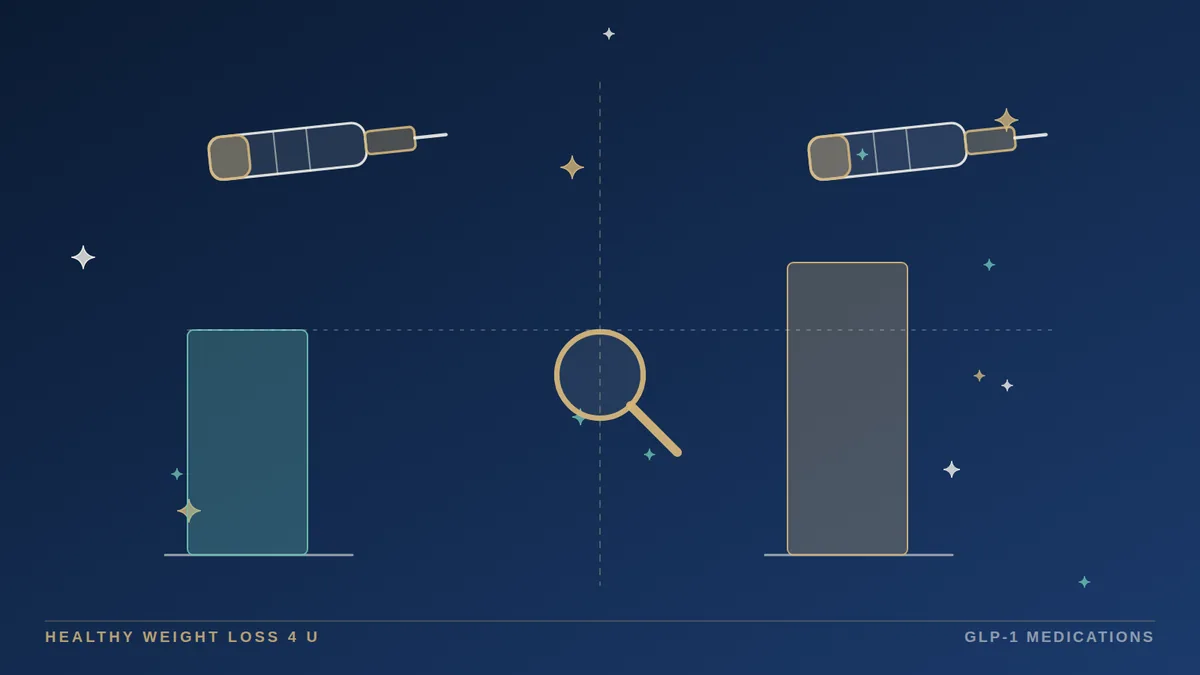
In SURMOUNT-5, a head-to-head trial, adults with obesity lost an average 20.2% of body weight on tirzepatide versus 13.7% on semaglutide over 72 weeks (open-label, maximum tolerated dose). Earlier placebo-controlled trials reported 14.9% for semaglutide 2.4 mg (STEP 1, 68 weeks) and 15.0% to 20.9% for tirzepatide 5 to 15 mg (SURMOUNT-1, 72 weeks). These are trial averages, individual results vary, and a licensed clinician decides which medication, if any, is appropriate.
Key takeaways
- SURMOUNT-5 randomized 751 adults without type 2 diabetes: -20.2% tirzepatide vs -13.7% semaglutide at 72 weeks (P<0.001).
- STEP 1 (1,961 adults, 68 weeks): -14.9% with semaglutide 2.4 mg vs -2.4% with placebo.
- SURMOUNT-1 (2,539 adults, 72 weeks): -15.0%, -19.5% and -20.9% with tirzepatide 5, 10 and 15 mg vs -3.1% with placebo.
- Gastrointestinal effects were the most common adverse events with both drugs, mostly mild to moderate and mainly during dose escalation.
- Wegovy (semaglutide) and Zepbound (tirzepatide) are the FDA-approved weight-management brands; Ozempic and Mounjaro are labeled for type 2 diabetes.
Which semaglutide and tirzepatide brands are FDA-approved, and for what?
Wegovy (semaglutide) and Zepbound (tirzepatide) carry weight-management indications; Ozempic (semaglutide) and Mounjaro (tirzepatide) are labeled for type 2 diabetes. The table below reflects the current labels and FDA announcements as of October 8, 2026 [1][2][8][9].
The Wegovy label (revised 06/2026) lists three injection indications: reducing the risk of major cardiovascular events in adults with established cardiovascular disease and obesity or overweight; reducing excess body weight and maintaining weight reduction in adults and in pediatric patients aged 12 and older with obesity, and in adults with overweight plus a weight-related condition; and treating noncirrhotic MASH with moderate to advanced liver fibrosis, under accelerated approval [2]. The same label covers a once-daily Wegovy tablet, which Novo Nordisk announced as FDA-approved on December 22, 2025 [12], and a 7.2 mg higher injection dose that the FDA approved on March 19, 2026 [11].
The Zepbound label (revised 8/2026) lists two indications in adults: reducing excess body weight and maintaining weight loss long term in adults with obesity, or overweight plus at least one weight-related comorbidity, and treating moderate to severe obstructive sleep apnea in adults with obesity [1]. Its pediatric safety and effectiveness have not been established [1].
A newer oral option also exists. The FDA approved Foundayo (orforglipron), a once-daily oral GLP-1 receptor agonist tablet from Eli Lilly, on April 1, 2026, to reduce excess body weight and maintain weight reduction long term in adults with obesity, or with overweight plus a weight-related condition [10]. It is outside the scope of the trials compared here. Compounded versions of semaglutide and tirzepatide are not FDA-approved products, a topic covered in our article on brand-name versus compounded GLP-1 drugs.
| Brand | Active ingredient | Labeled uses (summary) |
|---|---|---|
| Wegovy (injection and tablets) | Semaglutide | Weight reduction and long-term maintenance (adults; injection also ages 12+ with obesity); cardiovascular risk reduction in adults with established CVD and obesity or overweight; MASH F2-F3 (injection, accelerated approval) [2][12] |
| Zepbound | Tirzepatide | Weight reduction and maintenance in adults; moderate to severe obstructive sleep apnea in adults with obesity [1] |
| Ozempic | Semaglutide | Type 2 diabetes: glycemic control, cardiovascular and kidney risk reduction; the label lists no weight-loss indication [9] |
| Mounjaro | Tirzepatide | Type 2 diabetes: glycemic control (ages 10+) and cardiovascular risk reduction in adults at high risk [8] |
| Foundayo | Orforglipron | Weight reduction and long-term maintenance in adults with obesity, or with overweight plus a weight-related condition; approved April 1, 2026 [10] |
Source: [5] Aronne et al., N Engl J Med 2025
What did the STEP 1 trial show for semaglutide?
STEP 1 found a mean weight change of -14.9% with semaglutide 2.4 mg versus -2.4% with placebo after 68 weeks in adults without diabetes [3]. It was a double-blind trial in 1,961 adults with obesity (BMI of at least 30) or overweight (BMI of at least 27) plus a weight-related condition, randomized 2:1 to weekly semaglutide or placebo, with a lifestyle intervention in both groups [3].
The difference between groups was 12.4 percentage points (95% confidence interval -13.4 to -11.5). At least 5% weight loss was reached by 86.4% on semaglutide versus 31.5% on placebo, at least 10% by 69.1% versus 12.0%, and at least 15% by 50.5% versus 4.9% [3].
Nausea and diarrhea were the most common adverse events, usually mild to moderate and transient. Gastrointestinal events led to discontinuation in 4.5% on semaglutide versus 0.8% on placebo [3]. The trial was published in The New England Journal of Medicine in 2021 and funded by Novo Nordisk [3].
What did the SURMOUNT-1 trial show for tirzepatide?
SURMOUNT-1 found mean weight changes of -15.0% (5 mg), -19.5% (10 mg) and -20.9% (15 mg) with tirzepatide versus -3.1% with placebo at 72 weeks in adults without diabetes [4]. The trial randomized 2,539 adults 1:1:1:1; the Zepbound label reports a mean baseline body weight of 104.8 kg, a mean BMI of 38 kg/m2, a mean age of 45 years and 68% female participants [1].
Responder rates in the label's analysis were at least 5% weight loss in 85.1%, 88.9% and 90.9% of participants on 5, 10 and 15 mg versus 34.5% on placebo; at least 10% in 68.5%, 78.1% and 83.5% versus 18.8%; and at least 15% in 48.0%, 66.6% and 70.6% versus 8.8% [1]. The published abstract reports at least 20% weight loss in 50% on 10 mg and 57% on 15 mg versus 3% on placebo [4].
Most adverse events were gastrointestinal, mostly mild to moderate, and mainly during dose escalation. Discontinuation because of adverse events was 4.3% (5 mg), 7.1% (10 mg) and 6.2% (15 mg) versus 2.6% with placebo [4].
In people with type 2 diabetes the average loss was smaller. In the label's second study of 938 adults with BMI of at least 27 and type 2 diabetes, mean change at 72 weeks was -12.8% (10 mg) and -14.7% (15 mg) versus -3.2% on placebo [1].
Is there a head-to-head trial of tirzepatide versus semaglutide?
Yes. SURMOUNT-5 is a phase 3b, open-label randomized trial of 751 adults with obesity and without type 2 diabetes, published in The New England Journal of Medicine in 2025. Tirzepatide produced a mean weight change of -20.2% versus -13.7% with semaglutide at 72 weeks (P<0.001) [5].
Participants received the maximum tolerated dose by weekly injection: tirzepatide 10 or 15 mg versus semaglutide 1.7 or 2.4 mg [5]. The between-group gap of about 6.5 percentage points is our own subtraction of the two published means. Waist circumference fell 18.4 cm with tirzepatide versus 13.0 cm with semaglutide (P<0.001) [5].
Secondary threshold results, as reported by HCPLive (the percentages are not in the published abstract, and we could not open the full NEJM text to confirm them), favored tirzepatide at every level: at least 10% weight loss in 81.6% versus 60.5%, at least 15% in 64.6% versus 40.1%, at least 20% in 48.4% versus 27.3%, and at least 25% in 31.6% versus 16.1% [6]. TCTMD's coverage of the topline report gives the same 25% figures [7].
Gastrointestinal events were the most common adverse events in both groups, mostly mild to moderate and mainly during dose escalation [5]. The trial was funded by Eli Lilly, the maker of tirzepatide, and is registered as NCT05822830 [5].
| Trial | Population and design | Duration | Weight change (mean) | At least 15% loss |
|---|---|---|---|---|
| STEP 1 (semaglutide 2.4 mg) [3] | 1,961 adults, obesity or overweight plus a condition, no diabetes; double-blind vs placebo | 68 weeks | -14.9% vs -2.4% placebo | 50.5% vs 4.9% |
| SURMOUNT-1 (tirzepatide 5/10/15 mg) [1][4] | 2,539 adults, obesity or overweight, no diabetes; double-blind vs placebo | 72 weeks | -15.0% / -19.5% / -20.9% vs -3.1% placebo | 48.0% / 66.6% / 70.6% vs 8.8% |
| SURMOUNT-5 (tirzepatide vs semaglutide) [5] | 751 adults with obesity, no diabetes; open-label; maximum tolerated dose | 72 weeks | -20.2% tirzepatide vs -13.7% semaglutide | 64.6% vs 40.1% (as reported by HCPLive [6]) |
How do the side effects compare?
Both drugs cause mainly gastrointestinal side effects, which in the trials occurred mainly during dose escalation [4][5]. The prescribing information tables below come from different trial populations, so the percentages should not be compared head to head [1][2].
In the Wegovy label, nausea occurred in 44% of adults on 2.4 mg versus 16% on placebo, diarrhea in 30% versus 16%, vomiting in 24% versus 6%, and constipation in 24% versus 11% [2]. In the Zepbound label's pooled weight-reduction studies, nausea occurred in 25%, 29% and 28% on 5, 10 and 15 mg versus 8% on placebo, and diarrhea in 19%, 21% and 23% versus 8% [1].
Permanent discontinuation due to adverse reactions in the Zepbound label was 4.8% (5 mg), 6.3% (10 mg) and 6.7% (15 mg) versus 3.4% on placebo, with gastrointestinal reactions driving most of it, mainly in the first few months [1]. Both drugs carry a boxed warning for thyroid C-cell tumors based on rodent studies, with unknown relevance to humans, and are contraindicated with a personal or family history of medullary thyroid carcinoma or Multiple Endocrine Neoplasia syndrome type 2 [1][2]. Pancreatitis, acute gallbladder disease, acute kidney injury from dehydration and pulmonary aspiration during anesthesia are among the labeled warnings for both [1][2].
| Reaction | Wegovy 2.4 mg [2] | Wegovy placebo [2] | Zepbound 5 / 10 / 15 mg [1] | Zepbound placebo [1] |
|---|---|---|---|---|
| Nausea | 44 | 16 | 25 / 29 / 28 | 8 |
| Diarrhea | 30 | 16 | 19 / 21 / 23 | 8 |
| Vomiting | 24 | 6 | 8 / 11 / 13 | 2 |
| Constipation | 24 | 11 | 17 / 14 / 11 | 5 |
| Abdominal pain | 20 | 10 | 9 / 9 / 10 | 5 |
| Hair loss | 3 | 1 | 5 / 4 / 5 | 1 |
How should these trial results be read?
Trial averages describe groups, not individuals, and the three trials differ in ways that limit direct comparison. STEP 1 lasted 68 weeks and the SURMOUNT trials 72 weeks, STEP 1 and SURMOUNT-1 were placebo-controlled while SURMOUNT-5 compared two active drugs, and STEP 1 was funded by Novo Nordisk, while SURMOUNT-1 and SURMOUNT-5 were funded by Eli Lilly [3][4][5].
SURMOUNT-5 is the most direct comparison, but it has features worth noting. It was open-label, so participants and investigators knew the assigned drug; it let each participant use the maximum tolerated dose, which differed between people; and its sponsor makes one of the two drugs [5]. It enrolled adults without type 2 diabetes, so it does not speak to results in people with diabetes, where the Zepbound label shows smaller average weight changes than in people without it [1].
Semaglutide's labeling has also evolved since STEP 1. The FDA approved a 7.2 mg dose of Wegovy on March 19, 2026, stating that it led to additional average weight reduction compared with previously approved doses; the FDA release gave no figures [11]. The SURMOUNT-5 comparison used semaglutide at up to 2.4 mg, so it does not test the 7.2 mg dose [5].
Finally, trial participants received lifestyle support and close follow-up. NIDDK notes that medications are meant to be used with a lifestyle program, and that after one year adults on a prescription medication plus lifestyle lose about 3% to 12% more of their starting weight than with lifestyle changes alone, a range that applies to prescription weight-loss medications as a group [13]. Neither trial predicts what any one patient will experience.
What this means in practice
The evidence supports the statement that tirzepatide produced greater average weight loss than semaglutide in one 72-week, open-label trial in adults without diabetes. It does not show that tirzepatide is the better choice for every person. Medication choice also depends on health history, other conditions, prior response, side-effect tolerance, insurance coverage, cost and supply, and the labeled indications that fit the person, such as sleep apnea for Zepbound or established cardiovascular disease for Wegovy [1][2].
Useful questions for a first visit: which FDA-approved product is being considered and for which labeled indication; what dose-escalation schedule the prescribing information describes; which side effects to expect early; what monitoring is planned; and what the plan is for nutrition, protein intake and activity alongside the medication. Our related articles cover the first 12 weeks of treatment and side-effect management.
When to talk to a clinician: red flags
Do not start or switch between these medications without a licensed clinician's evaluation. Tell the clinician about any personal or family history of medullary thyroid carcinoma or MEN 2, a history of pancreatitis or gallbladder disease, diabetes and the medicines used for it, kidney problems, pregnancy or plans to become pregnant, and any planned surgery or sedation [1][2].
Seek prompt medical advice for a mass in the neck, trouble swallowing, persistent hoarseness, signs of dehydration, or any symptom you suspect is a serious allergic reaction, and report side effects that are severe or do not improve [1][2]. Both labels advise discontinuing the drug if pancreatitis is suspected [1][2].
Frequently asked questions
Is tirzepatide more effective than semaglutide for weight loss?
What are the FDA-approved brand names for semaglutide and tirzepatide?
How long were the STEP 1 and SURMOUNT-1 trials?
Do semaglutide and tirzepatide have the same side effects?
Was SURMOUNT-5 funded by the drug maker?
Are the trial weight-loss numbers what I should expect?
Sources
- ZEPBOUND (tirzepatide) injection: Full Prescribing Information (revised 8/2026). Eli Lilly and Company, 2026. uspl.lilly.com/zepbound/zepbound.html
- WEGOVY (semaglutide) injection and tablets: Full Prescribing Information (revised 06/2026). Novo Nordisk, 2026. novo-pi.com/wegovy.pdf
- Once-Weekly Semaglutide in Adults with Overweight or Obesity (STEP 1), N Engl J Med 2021;384:989-1002. The New England Journal of Medicine, 2021. doi.org/10.1056/NEJMoa2032183
- Tirzepatide Once Weekly for the Treatment of Obesity (SURMOUNT-1), N Engl J Med 2022;387:205-216. The New England Journal of Medicine, 2022. doi.org/10.1056/NEJMoa2206038
- Tirzepatide as Compared with Semaglutide for the Treatment of Obesity (SURMOUNT-5), N Engl J Med 2025;393:26-36. The New England Journal of Medicine, 2025. doi.org/10.1056/NEJMoa2416394
- SURMOUNT-5: Tirzepatide (Zepbound) Proves Benefit Over Semaglutide (Wegovy) for Obesity. HCPLive, 2025. hcplive.com/view/surmount-5-tirzepatide-zepbound-proves-benefit-over-s
- Tirzepatide Bests Semaglutide for Weight Loss: SURMOUNT-5 Top-line Results. TCTMD, 2025. tctmd.com/news/tirzepatide-bests-semaglutide-weight-loss-surmount-5-to
- MOUNJARO (tirzepatide) injection: Full Prescribing Information (revised 8/2026). Eli Lilly and Company, 2026. uspl.lilly.com/mounjaro/mounjaro.html
- OZEMPIC (semaglutide) injection: Full Prescribing Information (revised 05/2026). Novo Nordisk, 2026. novo-pi.com/ozempic.pdf
- FDA Approves First New Molecular Entity Under National Priority Voucher Program (Foundayo, orforglipron). U.S. Food and Drug Administration, 2026. fda.gov/news-events/press-announcements/fda-approves-first-new-molecul
- FDA Approves Fourth Product Under National Priority Voucher Program, Higher Dose Semaglutide. U.S. Food and Drug Administration, 2026. fda.gov/news-events/press-announcements/fda-approves-fourth-product-un
- FDA Approves Oral Wegovy Pill. Novo Nordisk U.S. (company press release), 2025. novonordisk-us.com/media/press-releases/wegovy-pill-fda-approval-obesi
- Prescription Medications to Treat Overweight & Obesity. National Institute of Diabetes and Digestive and Kidney Diseases (NIDDK), NIH, 2024. niddk.nih.gov/health-information/weight-management/prescription-medica
Keep reading
How GLP-1 Medications Work for Weight Loss
Read →Brand-Name vs Compounded GLP-1 Drugs: What the FDA Says
Read →First 12 Weeks on a GLP-1: What to Expect, Per the Labels
Read →Managing GLP-1 Side Effects: Nausea, Reflux, Red Flags
Read →Questions about your own situation? A clinician can review your history and goals. Related: Semaglutide Weight Loss, Tirzepatide Weight Loss.