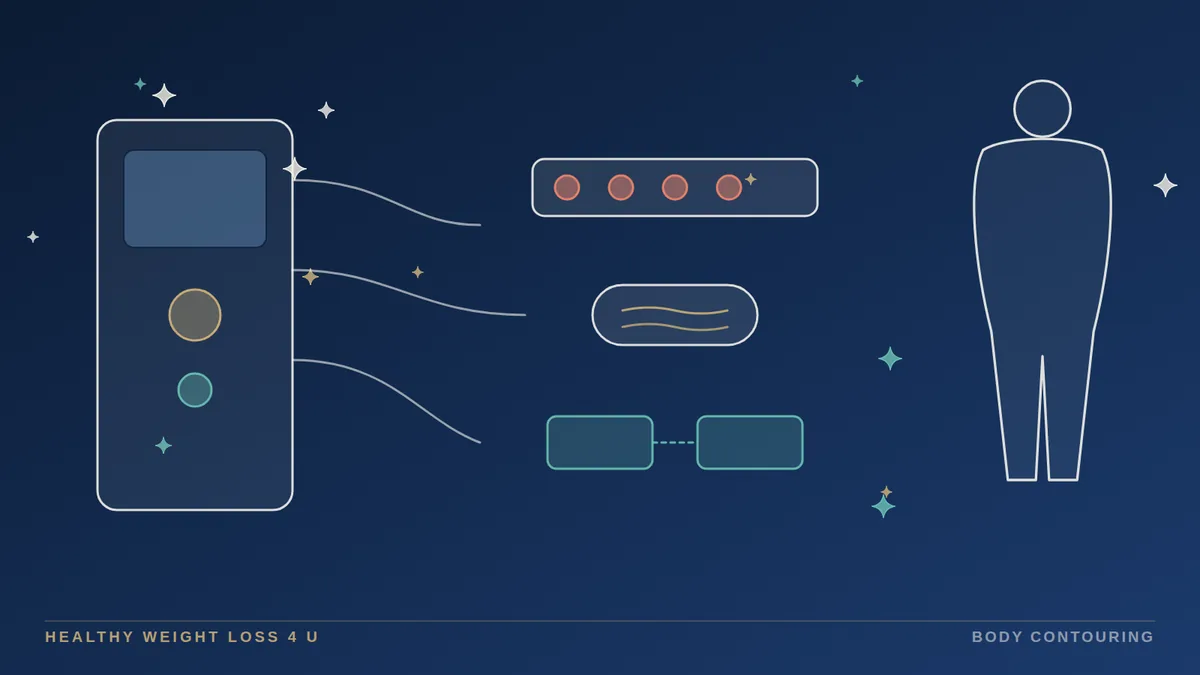
Venus Bliss Max is a three-part body contouring platform: a 1064 nm diode laser FDA-cleared for non-invasive lipolysis (fat reduction) of the abdomen, flanks, back and thighs in people with a BMI of 30 or less; a radiofrequency and magnetic-pulse applicator cleared for temporary reduction in the appearance of cellulite, plus minor muscle pain, spasm and circulation; and electrical stimulators cleared for muscle conditioning. It is not a weight-loss treatment, and the published fat-reduction studies are small, mostly open-label and tied to the manufacturer.
Key takeaways
- Three separate cleared functions: diode laser lipolysis (BMI 30 or less), RF with magnetic pulses for cellulite appearance, and EMS muscle conditioning [1][2].
- The FDA summaries for the device report no clinical testing; the human evidence comes from small published studies of the laser and RF combination [1][2][4].
- The largest published study found in this review had 39 participants and no randomized control group [4].
- Skin tightening, weight loss and treatment of visceral fat are not cleared indications [1][2][9].
- Pregnancy, open wounds, an unrepaired hernia and several medical conditions are listed by the manufacturer as reasons you may not be treated [8].
What is Venus Bliss Max?
Venus Bliss Max is a Venus Concept console that combines three different technologies: a diode laser, a multipolar radiofrequency applicator, and electrical muscle stimulation applicators. The FDA summary describes a console with four diode laser applicators, one MP2 applicator (RF plus pulsed electromagnetic fields plus vacuum) and four FlexMAX applicators for electrical muscle stimulation [1].
The laser emits at 1064 nm (infrared) in continuous-wave mode, with a power density up to 1.4 W/cm2 and a 6 x 6 cm spot size per applicator head, and the applicators include contact cooling [1]. The MP2 applicator is described as bipolar RF at 1 MHz with vacuum at -400 mbar and pulsed electromagnetic fields at 15 Gauss [1]. The FlexMAX applicators deliver biphasic electrical stimulation through two electrodes per applicator [1]. These are the manufacturer's engineering specifications as filed with the FDA, not measures of how well the device works.
The Lighthouse Point clinic lists Venus Bliss Max among its devices. Because the platform has several applicators, the useful question is always which applicator is being used for which goal.
What is Venus Bliss Max FDA-cleared to do?
The FDA clearances cover three separate functions, each with its own wording. The most recent record found (K220592, letter dated April 27, 2022) states that the device is a diode laser system intended for non-invasive lipolysis of the abdomen, flanks, back and thighs in individuals with a Body Mass Index (BMI) of 30 or less [2]. The earlier clearance (K213308, January 12, 2022) listed the abdomen and flanks only [1]. Venus Concept's press release of April 28, 2022 describes the expansion to the back and thighs [10].
For the MP2 applicator (RF energy combined with massage and magnetic field pulses), the cleared conditions are relief of minor muscle aches and pain, relief of muscle spasm, temporary improvement of local blood circulation, and temporary reduction in the appearance of cellulite [1][2]. For the FlexMAX applicators, the clearance is for muscle conditioning to stimulate healthy muscles, and the wording adds that the device is not intended to be used in conjunction with therapy or treatment of medical diseases or conditions of any kind and is to be operated by a trained professional [1][2].
Clearance is not approval. A 510(k) clearance means the FDA found the device substantially equivalent to a legally marketed predicate device. The records name earlier Venus devices (the Venus BlissMAX K213308 and the Venus Bliss K190743) as predicates, along with Cynosure SculpSure and Venus Legacy Pro [1][2][3]. The FDA summaries for the three records read for this article state that testing was bench, software and electrical safety testing, and K220592 states that no clinical testing was performed [1][2][3]. A cleared indication therefore describes what the device is allowed to be marketed for, not a measured result.
| Function | Cleared wording (summarized from FDA records) | Record |
|---|---|---|
| 1064 nm diode laser | Non-invasive lipolysis of the abdomen, flanks, back and thighs in individuals with a BMI of 30 or less | K220592 [2] |
| 1064 nm diode laser (earlier) | Non-invasive lipolysis of the abdomen and flanks, BMI of 30 or less | K213308 [1] |
| MP2 (RF, magnetic pulses, massage) | Relief of minor muscle aches and pain; relief of muscle spasm; temporary improvement of local blood circulation; temporary reduction in the appearance of cellulite | K213308, K220592 [1][2] |
| FlexMAX (EMS) | Muscle conditioning to stimulate healthy muscles; not for use with therapy or treatment of medical diseases or conditions | K213308, K220592 [1][2] |
How does the laser reduce fat?
The laser heats the fat layer, and the manufacturer says heated fat cells are damaged and then cleared by the body over time. The manufacturer describes laser heating of about 25 minutes per treatment that raises the fat layer to 42 to 46 degrees C [7]. Its published study protocol describes a 25-minute diode cycle with 4 minutes of warm-up and 21 minutes of exposure at 42 to 47 degrees C [6]. The manufacturer page also says the heated fat cells are then eliminated through the lymphatic system over time; that is a marketing claim, not a cleared indication or a measured result [7].
Direct proof of the mechanism in people is limited. The authors of the manufacturer-hosted 28-person study wrote that fat reduction is presumably due to collagen synthesis, a mechanism the paper did not directly demonstrate [6]. Treat the mechanism as a working explanation rather than an established fact.
What does the research show?
The best-documented Bliss-platform result is modest and comes from small, non-randomized studies. Gutowski and colleagues (Lasers in Surgery and Medicine, 2023) treated 39 people at four sites with three sessions eight weeks apart, each a diode laser treatment followed by vacuum-assisted PEMF and RF. Three blinded evaluators identified the correct before and after photographs 73.1% of the time, with an average grade of 1.12 on the photo scale. Ultrasound measured a 31.9% decrease in adipose tissue (p < 0.001), and the average satisfaction score was 7.8 out of 10. Six device-related adverse events were reported, all transient [4].
Several limits apply. The study was registered as open-label and baseline-controlled with no untreated comparison group, and Venus Concept is listed as lead sponsor [11]. The registry record lists a BMI under 35 for entry, which is above the BMI of 30 or less in the cleared indication [11]. The abstract describes thickness change on ultrasound, not weight, and it does not tell a patient how a given area will look or measure. Only the abstract record was available for this review, not the full paper, so the ultrasound method, the baseline thickness and the disclosures were not checked.
A 28-person study of the same laser plus RF combination, undated, is hosted on the manufacturer's site. It used the same three-session schedule at weeks 0, 8 and 16, graded photographs on a 0 to 3 scale with an average of 1.1 (slight change), and reported 4 mild events (3 palpable nodules, 1 bruise) that resolved [6]. It reported no circumference or fat-thickness measurements, had no control group, and did not state its funding [6].
The manufacturer's product page lists "up to 41% reduction in adipose layer thickness" under clinical results without citing a source for the figure; the only study it names is the 2021 Aesthetic Surgery Journal study of a 1060 nm diode laser [7]. The published abstract of the 2021 study (30 enrolled, 29 completed, single arm, ultrasound) reported an 8.55% reduction in adipose tissue 12 weeks after a single 25-minute treatment, with blinded evaluators correctly identifying before and after photographs 67% of the time at one site and 56% at the other [5]. The 41% figure could not be traced to that abstract or to any other source reviewed, so it is not repeated as a result. Treat it as an unverified manufacturer claim.
No randomized, sham-controlled trial of Venus Bliss Max was found in the sources reviewed for this article. The cellulite and muscle-conditioning functions are cleared on the basis of predicate devices, and the sources read here include no Bliss-specific clinical trial for either function.
What does a treatment course involve?
Only the manufacturer and the study protocols describe sessions, and individual plans are set by the treating clinician. Venus says a single fat treatment typically takes 25 minutes, that treatments should be performed 4 to 6 weeks apart, that the number of sessions depends on the person, and that there is no downtime and no physical restrictions [8]. The 39-person published study used three sessions at 8-week intervals with follow-up at 16 and 24 weeks [4].
The manufacturer page does not give a timeline for visible results [7][8]. It describes possible swelling, firmness or bruising, with tenderness that may take up to two weeks to resolve [8]. In the 28-person study, average pain scores were 2.9, 2.9 and 2.7 on a 0 to 10 Wong-Baker FACES scale across three visits [6].
Who is a reasonable candidate?
A reasonable candidate has a localized area of stubborn fat, a BMI of 30 or less for laser lipolysis, realistic expectations, and none of the exclusions below. The cleared laser indication is limited to BMI 30 or less [2], and the FDA states that non-invasive body contouring does not treat obesity or improve health and does not produce weight loss [9].
That makes the device a poor fit for someone whose main goal is to lose weight, and a poor fit for treating visceral (deep abdominal) fat. The manufacturer lists moderate to severe visceral fat, cellulite or loose skin in the treatment area among reasons you may not be treated [8]. For people on a medical weight-loss program, the more practical timing question is whether weight has been stable enough for any contouring result to be judged fairly. See the related article on who is a candidate for contouring versus weight loss.
Who should not have it, and what are the risks?
The FDA summaries for this device do not list contraindications [1][2], so the practical lists come from the manufacturer and the FDA's consumer page. Venus says you may not be able to receive fat treatment if you have open wounds or impaired wound healing, an unrepaired abdominal hernia, are pregnant or breastfeeding, have immunodeficiency or take immunosuppressants, have a coagulation disorder or a history of keloids, have neuropathy or impaired skin sensation, have a skin sensitivity disorder or take photosensitizing medication, have an active tan or heavy UV exposure within a week before or after, take certain blood thinners or aspirin above 81 mg daily, or have a history of squamous cell carcinoma or melanoma [8].
The FDA's body contouring page adds that radiofrequency devices should not be used by people with active implants such as pacemakers or implantable defibrillators, metal under the skin from an implant or injury, or metal-containing tattoo ink in the treated area, and that people with an IUD should ask their clinician about added risk. It lists RF risks as pain, redness, swelling, blisters, burns, nodules, skin color changes and scars. For light-based energy it lists pain, redness, swelling, blisters, burns and nodules, notes that light can injure the eyes, and advises people who are tan or take light-sensitizing medication to avoid it [9]. For pulsed magnetic and muscle-stimulating devices it lists muscle soreness and cramps and advises people with active implants or metal under the skin to avoid them [9].
The FDA also says some complications may last a long time, become permanent or require surgery to correct, and that many procedures give temporary improvement and may need repeat treatments [9]. In the published Bliss studies, reported events were mostly transient nodules, bruising and discomfort [4][6].
- Pregnancy or breastfeeding
- Pacemaker, implantable defibrillator or other active implant
- Metal under the skin or metal-containing tattoo ink in the treatment area
- Open wounds, impaired wound healing, unrepaired hernia
- Photosensitizing medication, recent tan, history of melanoma or squamous cell carcinoma
What this means in practice
Think of Venus Bliss Max as a localized contouring tool with modest, variable, measured effects, not a substitute for weight management. A clinician should be able to tell you which applicator is planned, which cleared indication it falls under, how many sessions the protocol assumes, and what the published evidence for that specific use shows. The evidence reviewed here supports small average reductions in measured fat thickness under study conditions, and it does not support promising any particular change in size, shape or weight for an individual.
When to talk to a clinician
Healthy Weight Loss 4 U programs begin with a clinician evaluation, and any device treatment should be preceded by a review of your history, medications and treatment area. The FDA lists blisters, burns, nodules and skin color changes among possible risks of these devices [9]. Contact the treating clinic promptly after a session for blisters, burns, severe or worsening pain, a hard lump that grows, unusual skin color changes, or tenderness that lasts longer than the provider told you to expect. Seek urgent care for symptoms that feel serious.
Questions to ask your provider
Bring a short list of questions to the consultation.
- Which Venus Bliss Max applicator will treat my goal, and what is the FDA-cleared indication for it?
- Am I within the BMI of 30 or less range for laser lipolysis?
- What do published studies show for this exact use, and how were results measured?
- How many sessions and what spacing do you plan, and who delivers the treatment?
- What are the exclusions that apply to me, including medications, implants, tattoos and hernia history?
- What happens if I see little or no change?
Frequently asked questions
Is Venus Bliss Max FDA-approved?
Does Venus Bliss Max help you lose weight?
Does Venus Bliss Max tighten skin?
How many Venus Bliss Max sessions are needed?
Is there downtime after Venus Bliss Max?
Who should not get Venus Bliss Max?
Sources
- 510(k) K213308: Venus BlissMAX (summary and indications for use). U.S. FDA, Center for Devices and Radiological Health, 2022. accessdata.fda.gov/cdrh_docs/pdf21/K213308.pdf
- 510(k) K220592: Venus BlissMAX (summary and indications for use). U.S. FDA, Center for Devices and Radiological Health, 2022. accessdata.fda.gov/cdrh_docs/pdf22/K220592.pdf
- 510(k) K190743: Venus Bliss (summary and indications for use). U.S. FDA, Center for Devices and Radiological Health, 2019. accessdata.fda.gov/cdrh_docs/pdf19/K190743.pdf
- Clinical evaluation of the safety and efficacy of a 1064 nm diode laser, and vacuum assisted pulsed electromagnetic fields and multipolar radio frequency for noninvasive fat reduction of the abdomen and flanks (Gutowski et al., Lasers Surg Med 55(5):455-463). UT Southwestern Medical Center research record, 2023. utsouthwestern.elsevierpure.com/en/publications/clinical-evaluation-of
- Clinical Evaluation of the Safety and Efficacy of a 1060-nm Diode Laser for Non-Invasive Fat Reduction of the Abdomen (Kislevitz et al., Aesthet Surg J 41(10):1155-1165). UT Southwestern Medical Center research record, 2021. utsouthwestern.elsevierpure.com/en/publications/clinical-evaluation-of
- Safety and efficacy of a 1064nm diode laser, pulsed electromagnetic fields and multipolar RF (Gutowski, Kang, Kilmer, Batra; whitepaper). Venus Concept (manufacturer-hosted), n.d.. venusconcept.com/img/bliss_max/vbl_whitepaper.pdf
- Venus Bliss MAX product page. Venus Concept (manufacturer), n.d.. venus.ai/venus-bliss-max
- Non-invasive fat lipolysis (Venus Bliss and Venus Bliss MAX). Venus Concept (manufacturer), n.d.. venus.ai/non-invasive-fat-lipolysis
- Non-Invasive Body Contouring Technologies. U.S. Food and Drug Administration, 2025. fda.gov/medical-devices/aesthetic-cosmetic-devices/non-invasive-body-c
- Venus Concept Receives New FDA 510(k) Clearance for Venus BlissMAX (press release, April 28, 2022). Venus Concept investor relations, 2022. ir.venusconcept.com/news-releases/news-release-details/venus-concept-r
- Clinical evaluation of a diode laser, PEMF and vacuum assisted MP RF (study listing, sponsor Venus Concept). Medifind clinical trial listing (mirror of the trial registry record), n.d.. medifind.com/articles/clinical-trial/5795435
Keep reading
Body Contouring vs Weight Loss: Who Is a Candidate?
Read →Venus Legacy Treatment: What It Is Cleared to Do
Read →Loose Skin After Weight Loss: What Tightening Can and Can't Do
Read →Protect Muscle During Weight Loss: What the Evidence Shows
Read →Questions about your own situation? A clinician can review your history and goals. Related: Venus Bliss Max Body Sculpting.